Start with an ending, not a pile of riddles
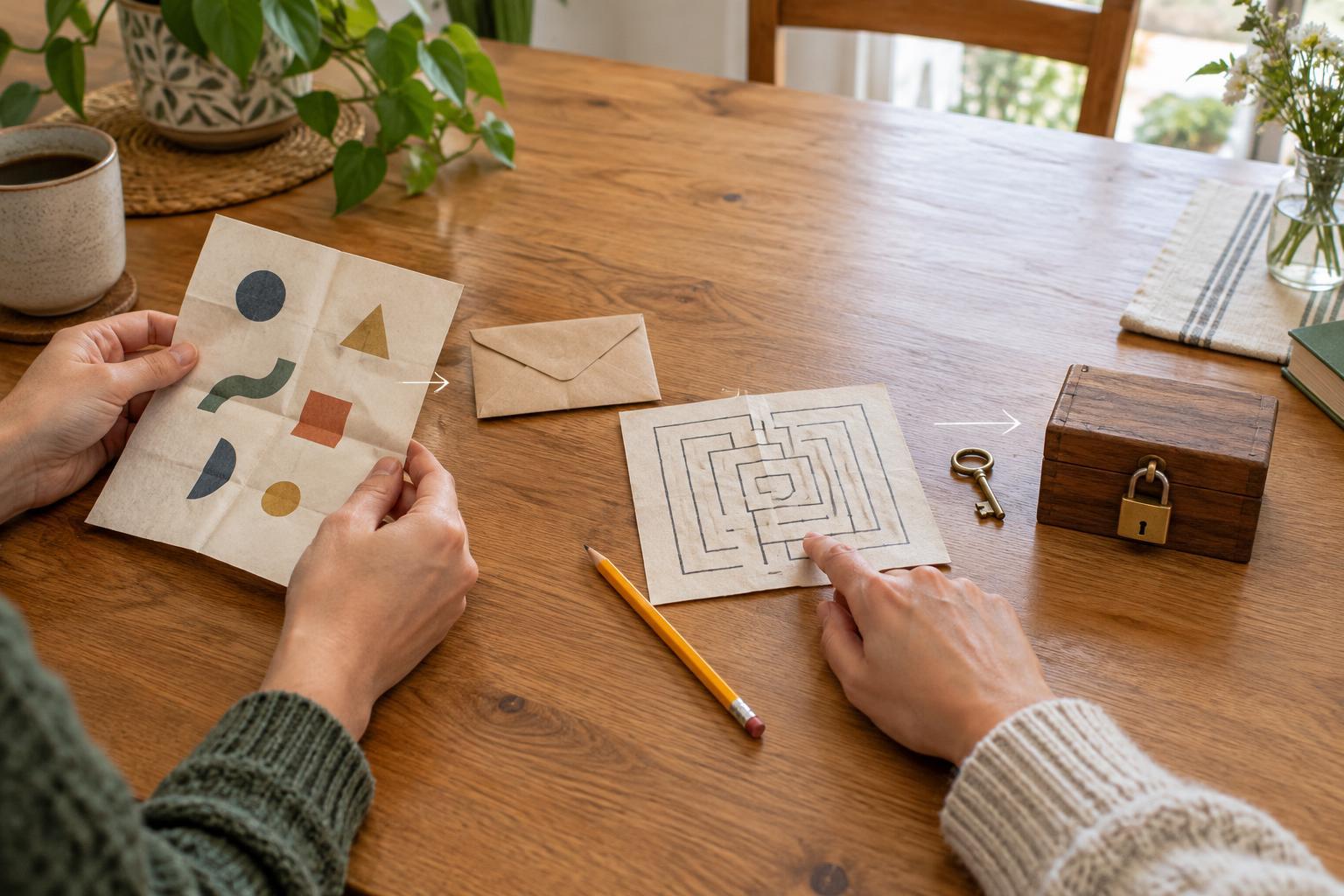
A small escape-room game works best when players can follow a clear trail: solve one clue, discover where to look next, and eventually reach a satisfying finish. You do not need locks, special props or an entire room. Three linked puzzles can fill a tabletop or a corner of a living room and still feel like an adventure.
Decide what players are trying to accomplish before writing clues. Perhaps they must find a missing page, deliver a pretend message or open a final envelope. Then work backward from that ending. Choose where the final item will be, what clue will point to it, and what earlier puzzle will reveal that clue. This keeps every activity connected to the goal instead of making players solve unrelated brainteasers.
Build a three-step trail
Here is a paper-based sequence you can adapt. Give players a short opening note and four lines of text whose first letters spell BLUE. A sentence in the note says, “The first letters will show you where to begin.” Put the next clue in a blue envelope among a few other colored envelopes. Players read the initial letters and select the blue one.
Inside, place three picture tiles showing a seed, a sprout and a flower. Write a different digit on the back of each tile: 4 behind the seed, 2 behind the sprout and 7 behind the flower. Add the instruction, “Put these in growth order, then turn them over.” The resulting number, 427, directs players to a paper envelope labeled 427. It need not be a combination for a real lock; an envelope label gives the same sense of progress.
In that envelope, put a picture of a distinctive book, cut into several pieces. Once players assemble it, they look for the matching book displayed in the play area. A final note tucked inside the book completes the story. Each solution has a specific job: BLUE identifies an envelope, 427 identifies another envelope, and the picture identifies the last location. If you change any of these answers, check that the matching object and clue still agree.
Make clues fair without making them obvious
Fair puzzles give players enough information to decide what to do, even if they need a moment to see the connection. “First letters” signals the acrostic method; “growth order” establishes a sensible order for the tiles. Without those prompts, guests might try every envelope or arrange the pictures according to size or color. A useful test is to ask whether a player could explain the intended answer using only materials available in the game.
Keep important objects visually distinct. If the final clue shows a book, use one with a recognizable cover rather than a drawing that could match several books on the shelf. Mark the boundaries of the game, too: tell players which table or area contains clues. Anything needed for the solution should be accessible without moving heavy furniture, taking apart household objects or searching personal belongings.
Theme can make simple mechanisms more engaging. The opening note might come from an absent museum curator, and the assembled picture might reveal the curator’s field journal. Keep story text brief enough that instructions remain easy to spot. The plot supplies a reason to continue; it should not hide essential rules.
Prepare hints and playtest the route
Write a hint for each step before anyone plays. Make the first hint a nudge, such as “Look at how each line begins.” If needed, follow it with a more direct hint: “Read the first letter of every line from top to bottom.” This gives a stuck group a way forward without immediately handing them the answer. A host can offer hints when the group asks rather than imposing a strict timer.
Run the sequence once with someone who has not seen the setup. Watch where they hesitate instead of explaining the puzzle as they go. If they find a different but reasonable answer, revise the clue or remove the ambiguity. Also check the physical route: is the numbered envelope easy to identify, and does the assembled picture point unmistakably to the intended book? After the test, reset every tile, envelope and final note for the next group.
Keep the game welcoming and easy to reset
A DIY escape room does not have to involve an actual locked room. Leave exits clear and let players know they can pause or stop at any time. For a mixed-age group, favor observations and ordering tasks over obscure trivia. Use readable text, avoid relying on color alone when possible, and let teammates discuss clues together.
After the game, ask which discovery felt most satisfying and which instruction caused uncertainty. Those answers can guide small improvements. Store each stage in its own labeled envelope so you can check the complete sequence quickly before another game night. With a clear goal, fair clues and a reliable reset, a few pieces of paper can become a complete shared adventure.