Start with a candidate, not a conclusion
A number sequence puzzle usually asks you to find a missing or next term. The tempting approach is to notice a familiar pattern and stop: 3, 6, 12, 24 looks like doubling, so the next number is 48. That is a sensible answer, but it is more precise to say that 48 follows if doubling is the intended rule. A short sequence alone rarely proves that one rule is the only possible rule.
Treat your first idea as a candidate. Check whether it explains every given term, not just the last two. Then ask whether another straightforward rule also fits. You do not need to invent increasingly elaborate alternatives; the goal is to avoid overlooking an ordinary interpretation because your first guess felt convincing.
Check the simplest changes first
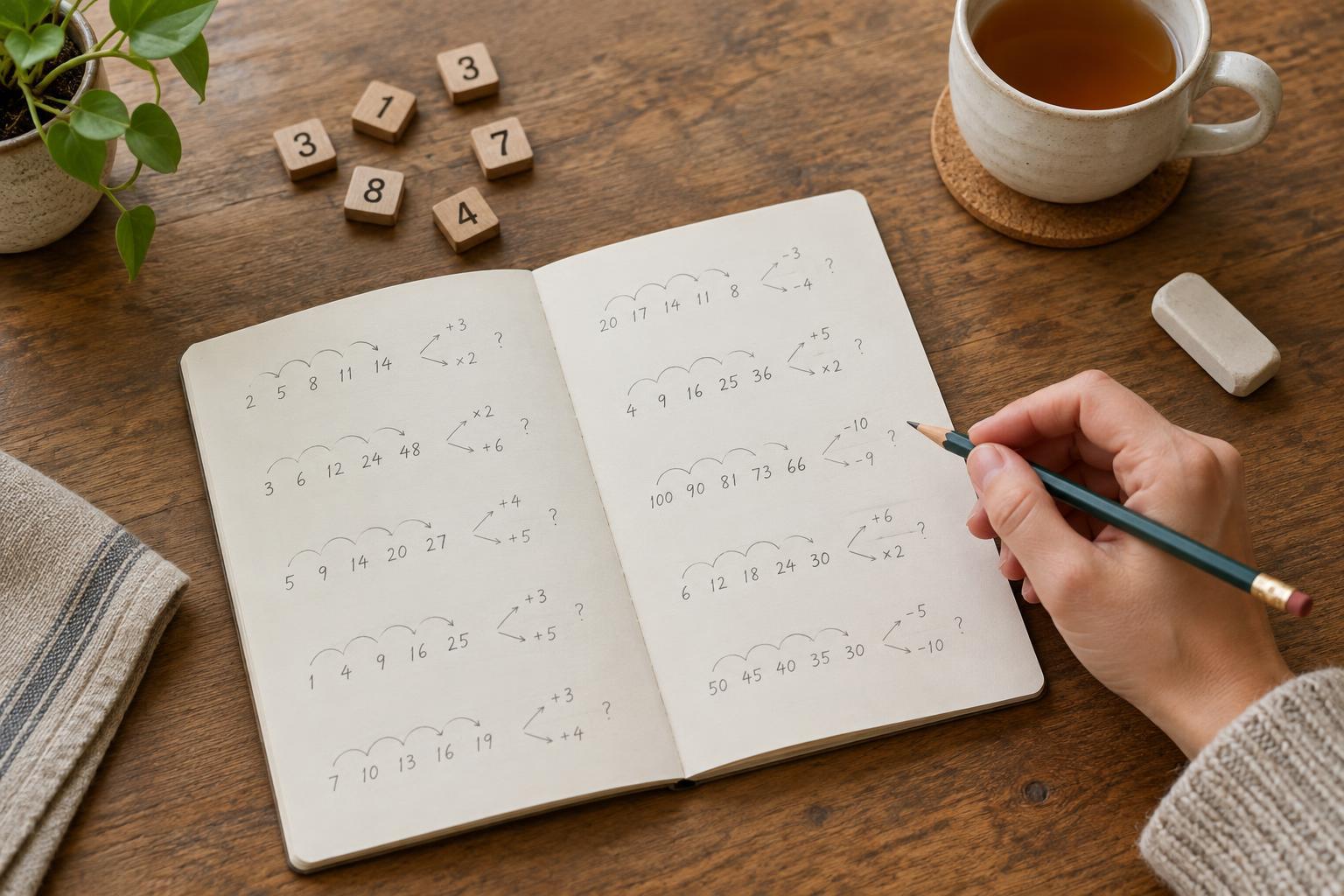
Write the gaps between neighboring terms. In 1, 2, 4, 7, 11, the differences are 1, 2, 3, 4. Continuing that pattern gives a gap of 5 and a next term of 16. If the gaps do not tell a clear story, check whether each term is multiplied by a consistent amount instead. Ratios are particularly useful when numbers grow quickly.
You can also compare differences between the differences. For 2, 5, 10, 17, the gaps are 3, 5, 7: consecutive odd numbers. A next gap of 9 would give 26. This method helps reveal a pattern that may be harder to see in the original list.
Keep the arithmetic visible on paper rather than doing every step mentally. A small subtraction error can make a useful rule look wrong. Equally, neat arithmetic is not a reason to force a rule onto terms it does not explain.
Look for structure beyond a single running rule
Some sequences alternate between two tracks. If a list seems to jump unpredictably, read the first, third, and fifth terms as one sequence and the second, fourth, and sixth as another. A puzzle might also repeat a cycle of operations, such as adding a number and then multiplying. Test the proposed cycle from the beginning to make sure it works at every step.
Other clues may come from familiar number groups: squares, cubes, or counting patterns. In 1, 4, 9, 16, the square numbers offer a compact explanation and suggest 25 next. The differences, 3, 5, 7, offer another way to describe the same continuation. Recognizing that two descriptions lead to the same answer can strengthen your confidence without establishing that no other continuation exists.
Consider the presentation, too. A puzzle in a chapter about multiplication may favor a different intended approach from one in a chapter about alternating patterns. Instructions, diagrams, and earlier examples are clues; they are not a substitute for checking the numbers.
Compare answers without making the puzzle needlessly complicated
When several rules fit, favor one that is clear, consistent, and appropriate to the puzzle’s setting. A rule that requires a special exception for one term is usually less persuasive than one that treats all terms alike. A rule built specifically to produce a surprising next number may be possible, but possibility alone does not make it a good explanation.
It helps to separate two questions: “What answer does this rule produce?” and “Why might this be the intended rule?” For a bare list such as 2, 4, 6, 8, continuing by adding 2 gives 10. You could construct a different rule that changes after 8, but without another clue, adding 2 is the simpler reading. If a puzzle provides more context, use it to weigh competing answers rather than insisting that the list has a uniquely determined future.
For group solving, invite people to state a rule before revealing their next number. That turns a disagreement over answers into a useful comparison of explanations.
Give an answer that shows your reasoning
A good final response names the rule and applies it: “The gaps increase by 1 each time, so the next gap is 5 and the next term is 16.” That short explanation lets someone else check your work. If the puzzle is ambiguous, you can say “One natural answer is…” rather than claiming certainty the clues do not support.
When you get stuck, reset in a consistent order: list the differences, check multiplication, split alternating positions, look for recognizable number groups, and reread any accompanying clues. Then pause. Staring at the same four numbers while generating ever more intricate rules often makes the task harder, not easier.
The pleasure of a sequence puzzle is not only arriving at a number. It is finding an explanation that makes the given terms feel connected—and knowing when the clues leave room for another one.