Start with the eight neighbors
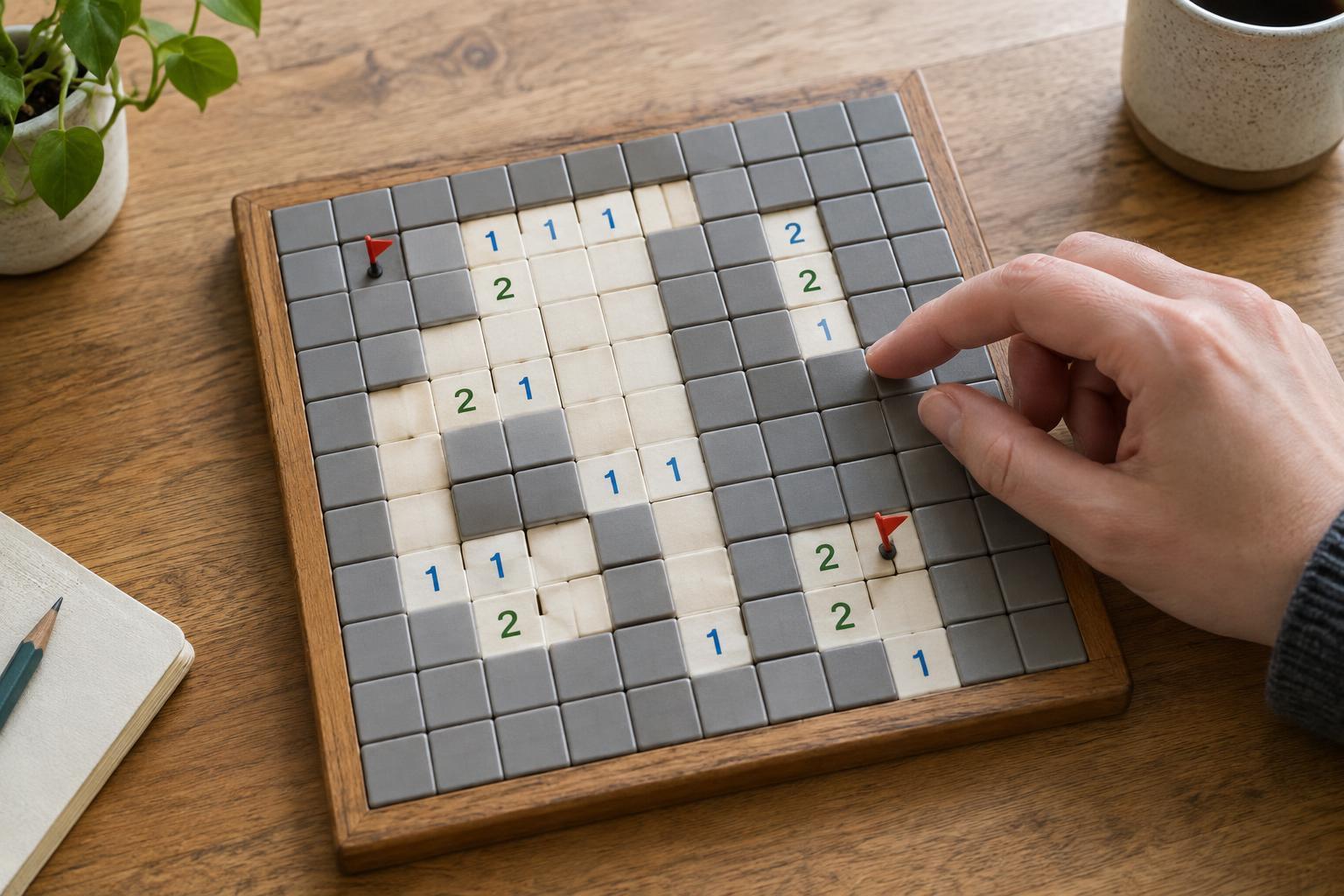
In Minesweeper, a revealed number tells you exactly how many mines occupy the squares touching it. Touching includes diagonals, so a square in the middle of the board can have up to eight neighbors. Squares along an edge have fewer, and corner squares have only three. The number describes that local group, not a row, a column or the entire board.
Imagine a revealed 1 with just one covered neighbor; all its other neighbors have already been revealed and are safe. That covered square must contain a mine. Now imagine a revealed 2 with exactly two covered neighbors. Both must be mines. The reverse is useful too: if a 2 already touches two squares you have established as mines, every other covered neighbor of that 2 is safe to open.
Before acting, check which squares actually touch the number. Diagonal neighbors are easy to overlook, especially near an uneven patch of revealed squares. It helps to trace a small box around the clue with your eyes rather than count only the squares directly above, below or beside it.
Count what is still unknown
A practical way to read any number is to separate its neighbors into known mines, revealed safe squares and covered squares whose contents remain unknown. Subtract the known mines from the number. The result is the number of mines still hidden among those unknown covered neighbors.
For example, suppose a 3 touches one mine you have confidently identified and three other covered squares. Two of those three covered squares must be mines. The clue has narrowed the possibilities, but it has not told you which two. Opening any one of them on that evidence alone would be a guess.
Flags can help you keep track, but a flag is a note placed by a player, not proof supplied by the board. If you flagged a square on a hunch, do not treat it as a known mine when subtracting from nearby numbers. A mistaken flag can make several otherwise sound deductions look convincing.
Compare clues that share covered squares
Some of the best deductions come from two numbers looking at almost the same unknown squares. Suppose a revealed 1 has exactly two covered neighbors, A and B. Together, A and B contain one mine. A nearby revealed 2 has exactly those same two covered neighbors plus a third, C, with no other unknown neighbors or known mines affecting its count. Because A and B already account for one mine, C must be the second mine.
The same comparison works in the other direction. If a 1 touches A and B, while another 1 touches A, B and C, then C must be safe, provided those are the complete sets of unknown neighbors for each clue. Both numbers require the same one mine somewhere in A and B; the extra square cannot contain another.
This is why the shape of a covered patch matters as much as the numbers beside it. Look for one clue whose unknown neighbors are a subset of another clue’s unknown neighbors. If the two clues still need the same number of mines, the extra squares beside the larger clue are safe. If the larger clue needs more mines, its extra squares must account for the difference.
Make one certain move at a time
When you find a forced mine, flagging it can make the surrounding numbers easier to read. When you find a forced safe square, opening it may reveal a new clue that resolves several nearby uncertainties. Reassess the board after each opening rather than committing to a long chain of moves based on a pattern you have not checked.
Some versions of Minesweeper let you open all unflagged neighbors of a satisfied number with a single shortcut or gesture. That can save time, but it relies on the adjacent flags being correct. If one flag was a guess, the shortcut may open a mine. For careful play, verify the count and the locations before using it.
A useful habit is to explain each move in a short sentence: “This 1 already has its mine, so these remaining neighbors are safe,” or “This 2 has only two unknown neighbors, so both are mines.” If you cannot finish the sentence without saying “probably,” look for another clue first.
Know when the clues are not enough
Not every covered square can be settled from the numbers currently visible. A 1 with two unknown neighbors tells you that one is a mine, but it does not distinguish between them. Check neighboring clues and other parts of the board for a safer move. A new reveal elsewhere may provide the information you need.
Depending on the board and its rules, you may eventually face a choice that the available clues cannot resolve with certainty. That does not mean you missed an obvious pattern. Minesweeper logic is about using the information you have: count accurately, compare overlapping groups and distinguish a deduction from a guess. The more often you make that distinction, the easier numbered squares become to read.