Start with the kind of session you want
The best jigsaw puzzle is not necessarily the largest one you can finish. It is one you will enjoy working on, whether that means a relaxed afternoon with friends or a project you return to over several evenings. Before looking at the box, decide where the puzzle will live and how long you are happy to leave it unfinished. A modest puzzle can be more enjoyable than an ambitious one if you have limited table space or prefer a clear stopping point.
Think about who will take part, too. If several people will work at once, a picture with distinct areas gives everyone something to tackle. If you usually puzzle alone, you might welcome an image that rewards slow, careful sorting. These preferences provide a better starting point than a piece count chosen in isolation.
Use piece count as a guide, not a difficulty rating
Piece count tells you roughly how much sorting and assembly lies ahead, but it cannot tell you exactly how hard a puzzle will feel. A 300-piece puzzle with a large stretch of nearly identical sky may be more demanding than a 500-piece puzzle full of recognizable objects. Likewise, the size and shape of individual pieces can affect how comfortably you can see and handle them.
For a short session or a first puzzle, a lower piece count offers a manageable way to learn what you enjoy. Mid-range counts suit people who want a project without committing a table for too long. Higher counts can be satisfying when you have a dedicated surface and like working in stages. If you are choosing for a group, consider the experience of the least enthusiastic participant; finishing together is often more fun than leaving someone with only indistinguishable background pieces.
Check the finished dimensions on the box before buying. Two puzzles with the same number of pieces may take up different amounts of space. Leave room around the finished size for the box lid, loose pieces, and small groups you have sorted. If your table serves other purposes, a portable puzzle board or a few shallow trays can make it easier to pause without losing your progress.
Read the image for clues about the experience
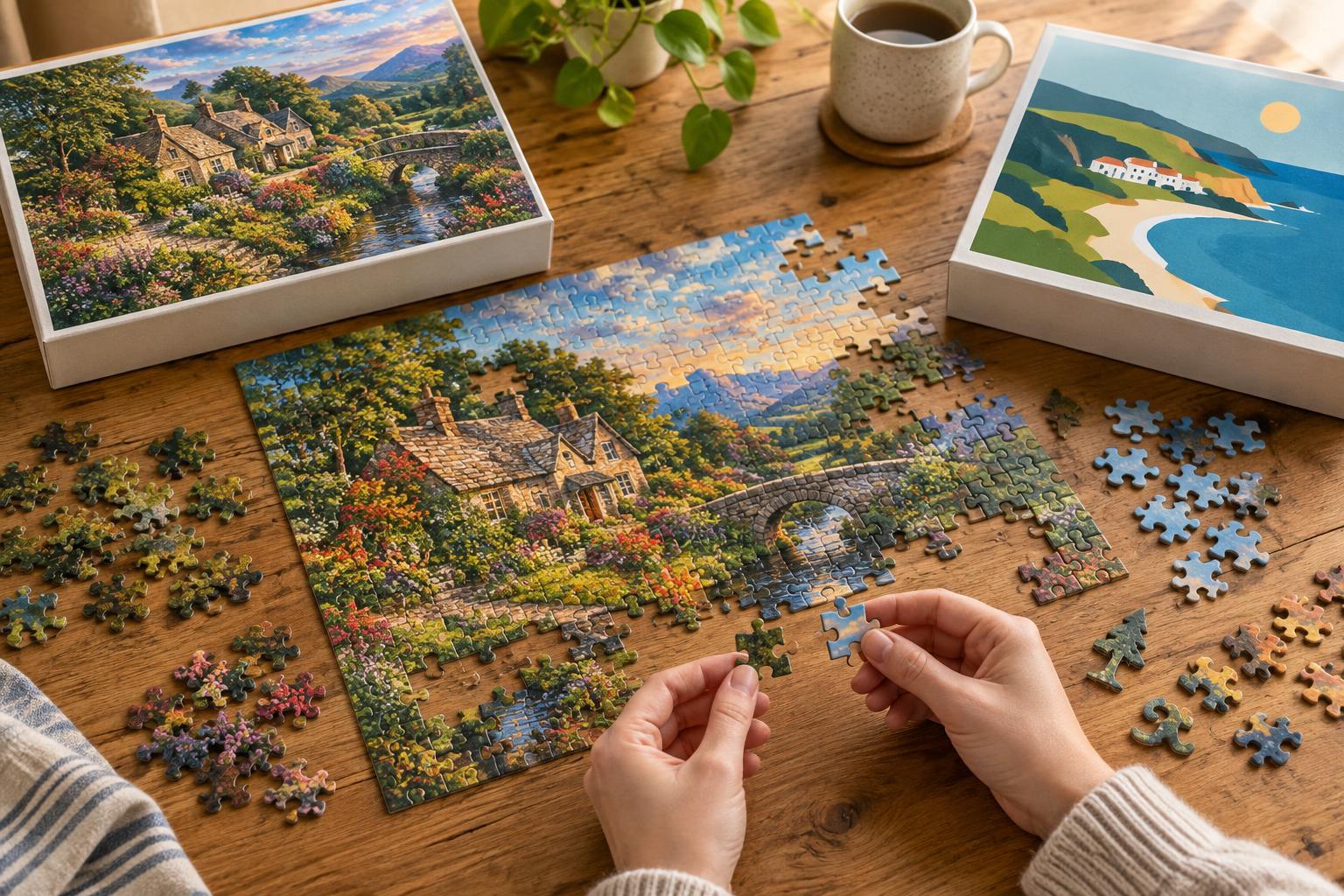
An appealing picture helps motivate you to finish, but it also determines how you will solve the puzzle. Images with varied colors, clear outlines, lettering, or many small objects offer frequent visual clues. You can sort pieces into useful groups and watch separate sections take shape. Busy illustrations may look complicated at first, yet their distinctive details can make individual pieces easier to place.
Large areas of one color, soft gradients, repeating patterns, and reflections offer fewer obvious clues. These can be enjoyable if you like studying subtle differences, but they may feel slow if you prefer steady, visible progress. Look closely at the box image rather than judging only by its subject. A landscape with several distinct buildings and trees may play very differently from one dominated by open water or sky.
Consider the printing and finish as part of the image choice. Strong contrast and sharp detail can help you compare pieces, while glare on a glossy surface may make close colors harder to distinguish under some lights. You do not need to avoid a favorite image because it looks challenging. Instead, pair it with a piece count and working space that make the challenge inviting.
Understand what cut style changes
Cut style describes the shapes of the pieces and how they interlock. Many puzzles use a regular, grid-like cut with familiar tabs and blanks. Rows and columns can sometimes be recognized, which gives you another clue when the image is difficult. Other puzzles use a more irregular or random cut, with greater variety in piece shapes and less predictable placement. Neither style is inherently better; they simply encourage different ways of solving.
A cut with highly similar shapes can make it tempting to press a piece into a place where it does not belong. A more varied cut may make shape-matching easier, though unusual pieces can take time to learn. Whatever the style, a correct fit should not require force. If a section looks wrong or lies unevenly, check the picture and nearby pieces before building further around it.
The way pieces connect also matters when you move completed sections. Some assembled areas hold together readily; others separate with a light touch. If you enjoy building small sections away from the main puzzle and sliding them into place, look for pieces that feel sturdy and fit cleanly. When possible, inspect a sample or read the product description for clues about the cut and piece size.
Make a balanced choice
For an easygoing group night, try a moderate piece count and an image with several colorful, distinct regions. For a quiet solo project, you might choose a higher count or a subtler image, but you do not need to increase both challenges at once. If you are curious about an unfamiliar cut style, start with an image you find easy to read so you can focus on how the pieces behave.
A good final check is to ask three questions: Do I want to look at this picture for hours? Do I have enough space to work and pause? Does the combination of piece count, image, and cut sound enjoyable rather than merely impressive? Choosing with those answers in mind makes it easier to find a puzzle you will want to return to, piece by piece.