Meet the seven pieces
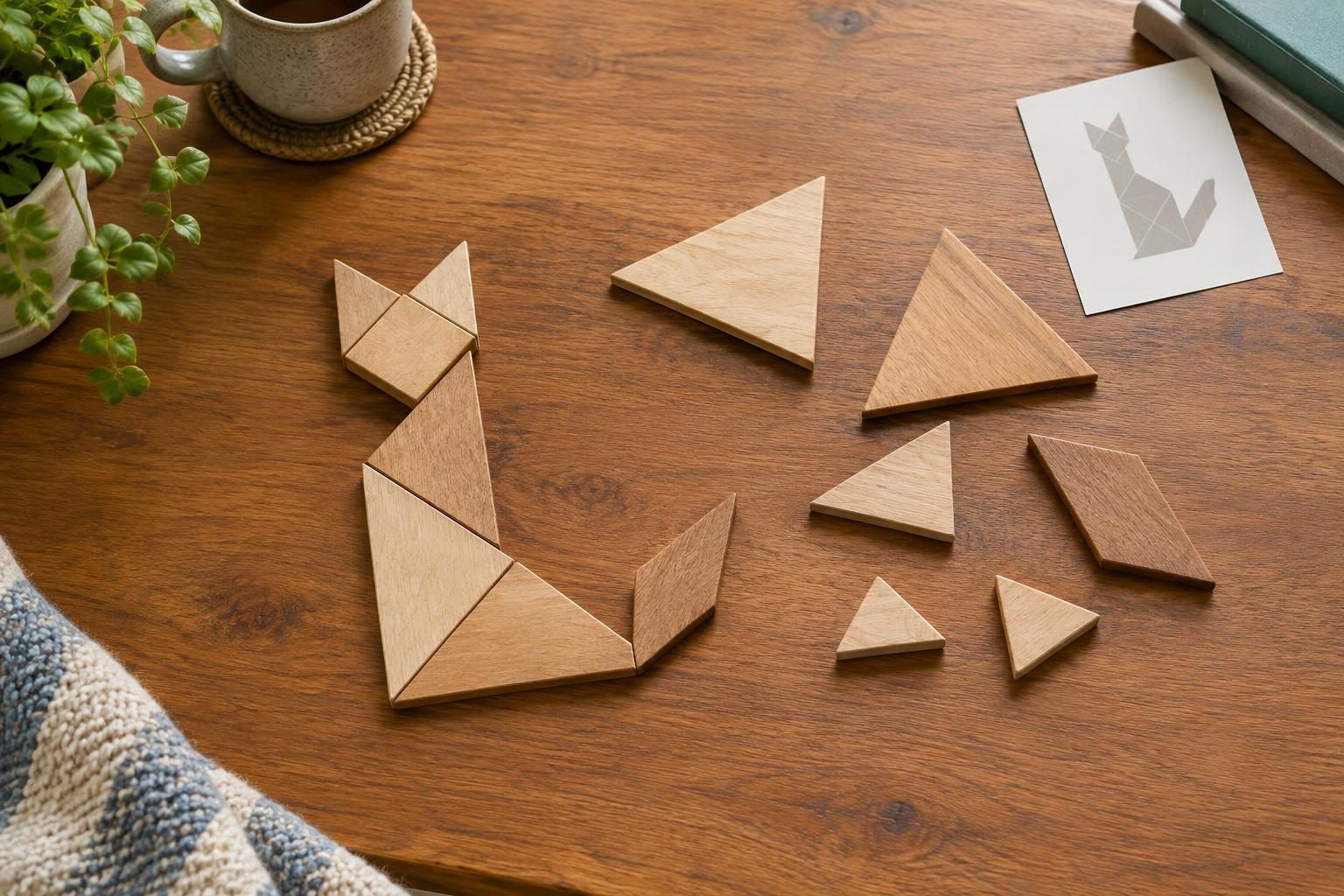
A tangram is a shape puzzle made from seven flat pieces, often called tans. A standard set has two large triangles, one medium triangle, two small triangles, one square, and one parallelogram. These simple shapes can be arranged into figures that suggest animals, people, objects, letters, and abstract designs. You can use a wooden set, cut pieces from stiff paper, or move shapes in a digital puzzle.
Before tackling a silhouette, spread out the pieces and compare them. Notice which triangles share the same shape but differ in size. Place two small triangles together in different ways: they can form a larger triangle, a square, or a parallelogram. Try rotating the square so it looks like a diamond. This quick exploration builds familiarity with edges and corners, making the pieces easier to recognize when they are hidden inside an outline.
How a tangram puzzle works
In a typical silhouette puzzle, you see only the outside edge of a figure. Your task is to reproduce it using all seven tans, without overlapping them or leaving gaps inside the intended shape. Pieces may touch along edges or at corners. You can rotate them freely. Some puzzles require you to flip the parallelogram over to make a mirrored arrangement; if you are using a digital set, look for a reflect or flip control.
Tangrams can also be used for open-ended play. Instead of matching a given outline, make your own figure and trace around it to create a puzzle for someone else. Keep the pieces still while tracing, and draw only the outer boundary if you want to hide the solution. There may be more than one way to fill some silhouettes, so the aim is to find an arrangement that works rather than to guess what the puzzle maker did.
Start with the outline, not the details
When a silhouette looks complicated, search first for its largest areas and longest straight edges. The two large triangles take up a substantial part of the set, so they are useful candidates for broad wings, roofs, bodies, or bases. A sharp outward point may suggest a triangle corner, while a narrow projection might be formed by a small triangle. These clues are possibilities, not fixed rules: several pieces can combine to make an edge that looks like it belongs to one.
Set a promising piece beside the outline before committing to a full arrangement. Ask whether its edges align with the silhouette and whether it leaves enough room for the remaining tans. If you create a small, awkward gap that none of your pieces can fill, reconsider an earlier placement. Working from the outside inward can help, but leave yourself permission to move pieces as new relationships become clear.
Use simple checks when you get stuck
If random rearranging stops helping, sort the unused pieces by size. Compare the space you have left with each piece individually and with pairs you have already tested. Check the direction of diagonal edges: a piece may seem nearly right but point the wrong way. The parallelogram deserves special attention because rotating it does not produce its mirror image. Turning over a physical piece may open up a fit you could not make before.
It can also help to remove every piece and rebuild from a different starting point. Begin with an obvious point or a long flat edge instead of the figure’s center, or place a large triangle where you previously used smaller pieces. Take a short break if the outline starts to look like a single confusing shape. Returning to it often makes corners and possible divisions easier to see.
Make tangrams part of a game night
For a relaxed group activity, give everyone the same set and silhouette, then invite them to explain how they approached it after they finish. You can offer an easier version by showing faint lines between the pieces, or a harder version by showing only the outer edge. If players have different levels of experience, let them choose a silhouette they find inviting rather than treating speed as the only measure of success.
For a creative round, ask each person to build a recognizable figure with all seven pieces and give it a name. Trace the outline, mix up the pieces, and pass the puzzle to a neighbor. If an outline proves difficult, its maker can offer a hint about where one large triangle belongs. Tangrams work well as both a quiet solo puzzle and a shared activity because every attempt encourages you to look at familiar shapes in a new way.