Start with one decision players will enjoy making
A two-player paper-and-pencil game does not need a detailed world or a long rulebook. It needs a decision that both players will face repeatedly. Will they extend a route or block one? Claim a useful space now or save a move for later? Choose one such tension before drawing the board. It gives you a way to judge every rule you add: does this rule make that decision more interesting?
Pick a short session as your first design target. A small board is easier to redraw, and a game that finishes quickly can be tested several times in one sitting. Decide what players can see, whether they take alternating turns, and how someone wins. If you cannot explain those three things in a few sentences, simplify the idea before adding special abilities or exceptions.
Build a tiny prototype with complete rules
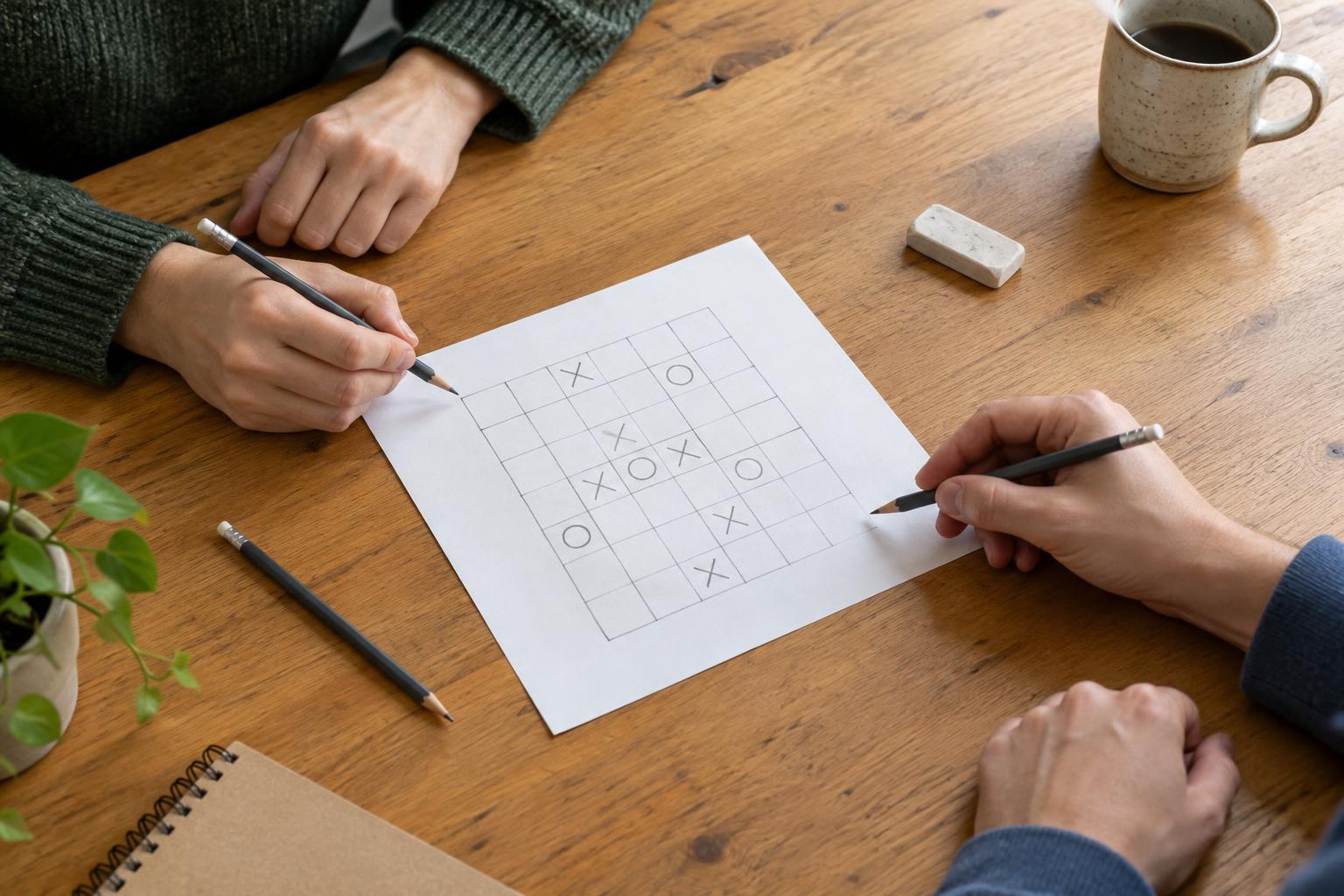
Try this route-building game as a starting point. Draw a grid of five rows and five columns. Player A writes A in the middle square of the top row; Player B writes B in the middle square of the left column. A wants to reach any square on the bottom row. B wants to reach any square in the right column. Player A takes the first turn, then players alternate.
On a turn, write your letter in one empty square directly above, below, left or right of any square containing your letter. Diagonal squares do not count. You may branch from an earlier mark rather than extend only your newest one. Once a square is marked, it stays marked and cannot be used by the other player. The first player to mark a square on their target edge wins. If you have no legal move, pass; if both players pass in succession, the game is a draw.
These rules fit beside the grid, so a new player can check them during play. They also create a choice: advance toward your target or occupy a square your opponent may need. The prototype may have awkward positions or a first-player advantage. That is useful information to discover, not a reason to avoid testing it.
Playtest for clarity before adding variety
Play the prototype once without stopping to revise it. Put a small question mark in the margin whenever either player hesitates over a rule, then settle the question using the written rules if possible. After the game, note where the hesitation occurred. Common trouble spots include whether a move can branch from an old square, whether diagonal contact counts and what happens when a player is trapped.
Next, play several short games while swapping who moves first and who starts on each edge. You do not need a score sheet full of numbers; brief notes such as “center fills too quickly” or “blocking feels stronger than building” are enough to guide a change. Ask each player which turns offered a meaningful choice and which felt automatic. A game can have perfectly clear rules yet still leave players with little to decide.
Change only one feature before testing again. You might enlarge the grid to six by six squares, move the starting marks or let each player place one neutral obstacle before play. Changing several features at once makes it harder to tell what helped.
Use the page to make play easier
Paper is part of the game’s interface. Draw squares large enough to write in without obscuring neighboring marks. Keep the win conditions in a corner of the page, and label the target edges if players are likely to forget them. If both players prefer symbols, use X and O instead of letters; the important thing is that the marks remain easy to distinguish.
Think about what a player can understand at a glance. A crowded board may call for a larger grid drawing, not a more complicated rule. If you add obstacles or special squares, give them a distinct mark and define their effect in one sentence. Avoid relying on colors alone when a pencil sketch would do.
Finish with the simplest version worth replaying
After a few tests, write a fresh rule sheet without your margin notes. Include setup, turn order, legal moves, the win condition and what happens when play stops without a winner. Give it to two people and watch a game without explaining anything unless they get stuck. Their questions will show which instructions still need work.
Do not feel obliged to eliminate every unusual outcome. A draw can be a satisfying result if both players understand how it happened. Keep a rule when it supports the game’s central decision; remove it when it mostly requires remembering an exception. The finished game may look different from your first sketch, but it should still offer what made that sketch promising: a clear goal and interesting choices made with only paper and pencil.