Start with the kind of play your group enjoys
Improv prompt cards give players a starting point, not a script. A card might name a location, suggest a relationship, or introduce a small problem. The fun comes from seeing what the group makes of it together. Before writing cards, decide whether your gathering would prefer quick comic scenes, collaborative stories, character experiments, or a mix. That choice will help you set the tone without deciding how any scene must end.
Think about the people who will use the deck. A group of close friends may enjoy familiar running jokes; a group with new members may do better with prompts that require no shared history. Keep the activity low-pressure from the outset: players can pass on a card, ask for a replacement, or take a supporting role. Those options make it easier to try something unfamiliar.
Build a small deck with distinct categories
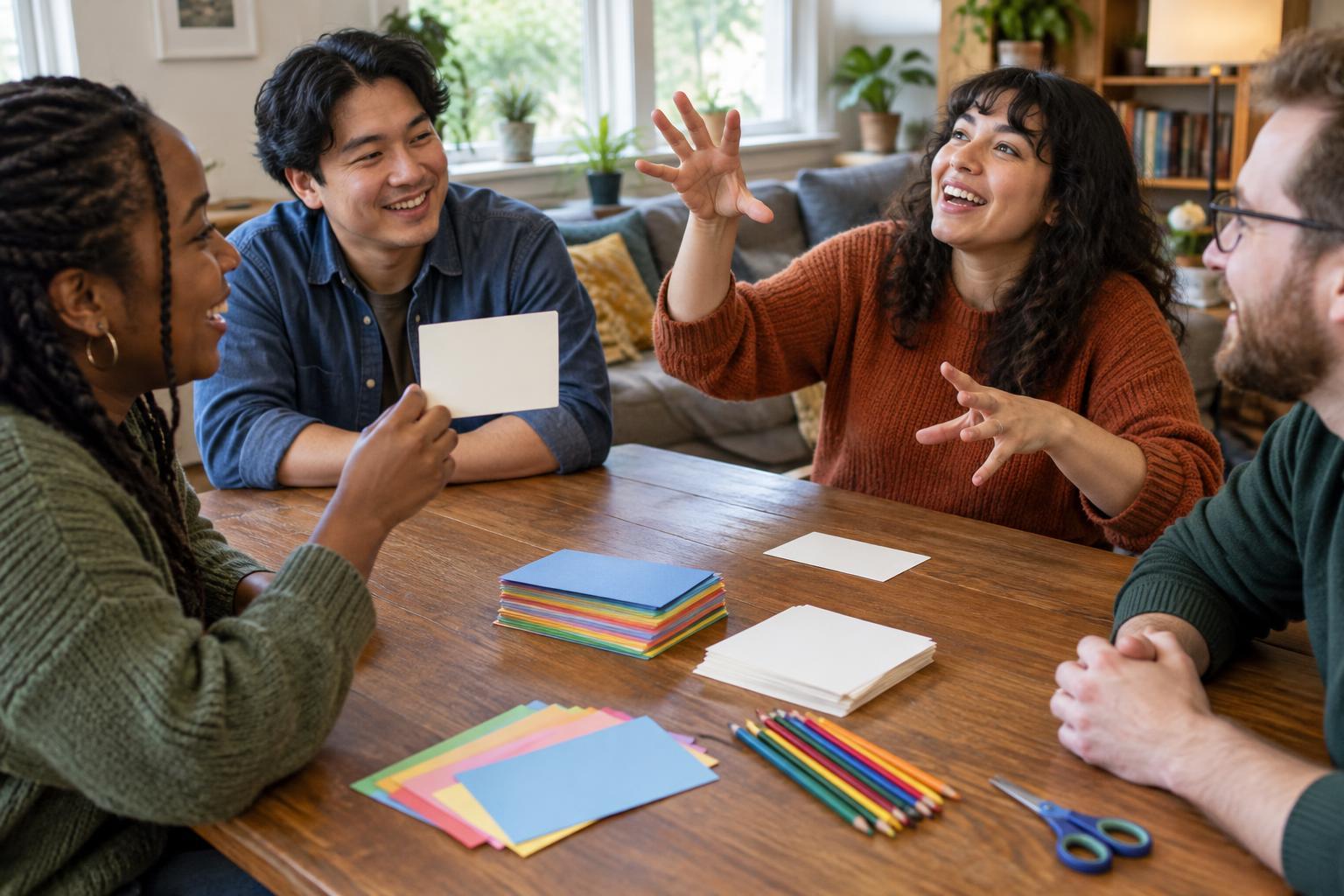
Cut index cards or sturdy paper to the same size, then choose three or four prompt categories. Locations, relationships, and gentle complications are a useful starting set. If you want another layer, add an object category. Mark each category with a word or color so players can sort the cards quickly. Around ten cards per category is plenty for a first session; you can add more after you see which ones spark ideas.
Write each card as a short, playable suggestion. A location could be “a museum after closing” or “a crowded community garden.” A relationship could be “two neighbors who keep receiving each other’s mail.” A complication could be “someone is trying to hide a harmless mistake.” An object could be “a key with no known lock.” Specific details give players something to use, while leaving room for them to decide who they are and what happens next.
Avoid prompts that already contain the whole plot, such as instructions for a surprise reveal and a final punch line. Also avoid making embarrassment the goal. A card about a lost umbrella offers more possible scenes than a card that demands someone play a fool. As you write, ask whether at least two people could respond to the prompt in different ways. If so, it is likely open enough to play.
Test the cards before game night
Shuffle each category and draw one card from two different piles. Say the combination aloud and imagine the first few lines of a scene. “A crowded community garden” plus “someone is trying to hide a harmless mistake” gives players an immediate situation, but it does not dictate the outcome. If a pairing is confusing, rewrite one card with a clearer action or more familiar setting.
Read the deck for tone as well as clarity. Remove cards that depend on specialized knowledge, stereotypes, or personal disclosures. You can include unusual settings without asking anyone to imitate a real person or reveal a private experience. Leave a few blank cards aside so players can suggest additions later, but agree that new cards enter the deck only after the group has had a chance to read them.
Run short rounds with room to experiment
For a first round, draw a location and a relationship card. Give two or three volunteers a moment to decide who they are, then let the scene unfold for a couple of minutes. Another player can call a gentle stop when the scene reaches a natural pause. The aim is not to produce a polished performance; it is to give everyone a manageable chance to build on an idea.
In later rounds, try drawing a complication card after the scene has begun. Players can incorporate it if it helps, or set it aside if it would derail a good moment. A host can also invite the audience to name something they enjoyed, such as a clever use of the setting or a generous offer from a scene partner. Keep feedback brief and encouraging rather than scoring performances. For anyone who would rather not act, drawing cards, suggesting a scene title, or managing the deck are useful ways to participate.
Refine and reuse your deck
After playing, separate the cards that led to lively scenes from the ones that repeatedly stalled. A stalled card is not a failure; it may simply be too vague, too restrictive, or too similar to another. Change one detail and try it again. For example, “a shop” might become “a shop preparing to close for the day,” giving players a reason to act without prescribing what they do.
Store the categories together with a few blank cards and a note about how your group likes to play. The next time you gather, you can swap in new settings, draw extra objects, or use the cards to tell one shared story instead of acting out separate scenes. A reusable deck is most valuable when it stays flexible enough to grow with its players.