What the numbers mean
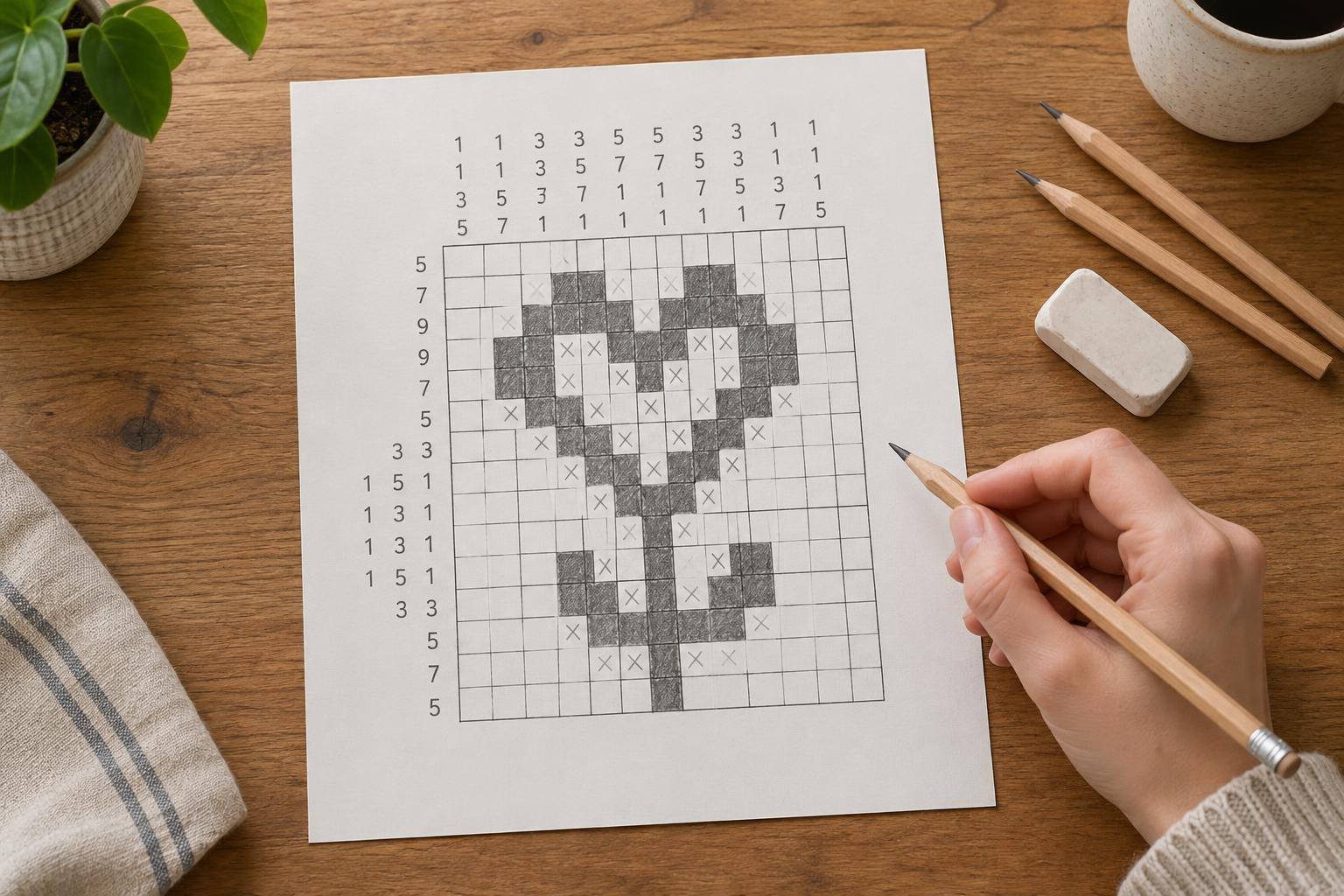
A nonogram is a grid puzzle in which you decide which cells to fill and which to leave empty. Numbers beside each row and above each column describe the filled cells in that line. As you satisfy both sets of clues, a picture emerges. You do not need to recognize the picture to solve the puzzle; the clues provide the information you need.
Each number represents a consecutive block of filled cells. If a row has the clue 4, it contains one run of four filled cells. If its clue is 2 3, it contains a run of two followed, from left to right, by a run of three. Separate runs must have at least one empty cell between them. Column clues work the same way, read from top to bottom. A line marked 0, when a puzzle uses that notation, has no filled cells.
The numbers give block lengths and order, not exact positions. A clue of 3 in a seven-cell row could fit in several places. Solving a nonogram means finding the positions that remain possible once the row and column clues are considered together.
Start with lines that reveal the most
First, look for any line whose blocks and required gaps use every cell. In a five-cell row with the clue 3 1, the blocks occupy four cells and need one empty cell between them. The only possible arrangement is three filled cells, one empty cell, then one filled cell. Mark all five cells immediately.
Even when a block can move, some of its cells may be certain. Imagine a seven-cell row with a single clue of 5. The block could start in the first, second, or third cell. In every placement, the third, fourth, and fifth cells are filled. Mark those three; leave the other cells undecided for now. This is called overlap: you fill only the cells shared by every possible placement.
Before marking a cell, count carefully. For multiple clues, add the block lengths and at least one separating cell between neighboring blocks. If the total exceeds the line length, a clue or grid dimension has been misread. If it equals the line length, the entire line is determined.
Use empty cells as clues, too
Many solvers mark known-empty cells with an X or a dot. This keeps them distinct from cells that are still unknown. Once you have placed every required filled cell in a line, mark its remaining cells empty. If a completed block touches the edge of a line, mark the cell immediately beyond its other end empty whenever another cell exists: a longer continuous run would contradict the clue.
Empty cells can split a line into smaller spaces. Suppose a row needs a block of four, but a known-empty cell leaves only three available cells on one side. That block cannot go there. It must fit in another open space. In the same way, if an open space is shorter than every remaining block, all its cells are empty.
Every mark has two effects. A cell belongs to both a row and a column, so progress in one direction may settle a question in the other. After working across several rows, scan the columns again. Repeating that pass is usually more productive than staring at one stubborn clue.
Follow a short deduction from row to column
Consider a seven-cell row with the clue 5. You fill its middle three cells because they overlap in every possible placement. Now inspect the column crossing one of those cells. If that column has a single clue of 1, its one filled cell is accounted for. Every other cell in the column is empty.
Those new empty marks may limit a different row. Perhaps that row has the clue 2 and now has only one pair of adjacent available cells. Both must be filled. This is the basic rhythm of nonogram solving: make a mark that is certain, check the crossing line, and use what you learn to return to the original direction.
When a line seems stuck, consider its remaining valid placements rather than choosing one that looks likely. Mark a cell only if every valid placement agrees about it. You can make steady progress without committing to a complete row or column at once.
Avoid common solving traps
Keep filled, empty, and unknown cells visually different. An unmarked cell is not necessarily empty, and treating it as such can create false deductions. Likewise, two numbered blocks cannot touch: without an empty cell between them, they would form one longer block. More than one empty cell between blocks is fine unless the available space rules it out.
If you reach a contradiction, retrace your most recent marks and check the clue order, gap count, and crossing lines. A nonogram may resemble a familiar object before it is complete, but its apparent picture is not proof that a cell should be filled. Let the numbers decide.
For a first puzzle, choose a small grid and work line by line. Look for exact fits, overlap, completed blocks, and spaces too short to hold a block. Those few habits make the grid easier to read—and turn the final image into a satisfying result of the logic rather than a guess.