The goal: fill every space without repeats
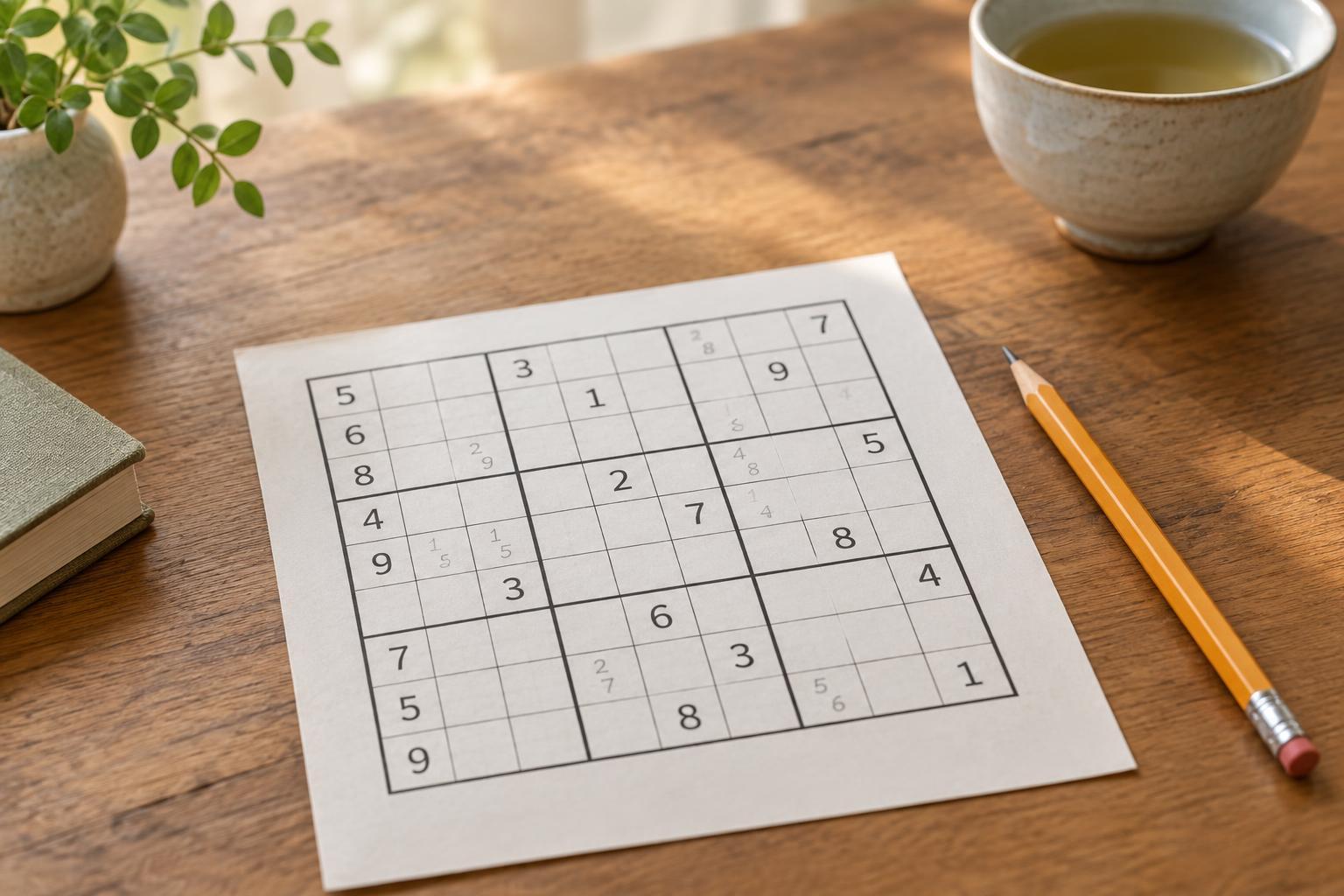
A standard Sudoku puzzle is a 9-by-9 grid divided into nine smaller 3-by-3 boxes. Some numbers are already printed in the grid; these are clues and should not be changed. Your job is to fill the empty cells with the digits 1 through 9. Each digit must appear exactly once in every row, every column, and every 3-by-3 box.
You do not need to add, subtract, or calculate. Sudoku is a placement puzzle: a number belongs in a cell only if it fits all three groups that share that cell. For example, if a row already contains a 6, none of its other empty cells can contain 6. The same restriction applies to a column or box that contains 6.
Beginners often focus on one group at a time, but every placement must satisfy all three. Before writing a number, look across its row, down its column, and around its box. If any of those groups already has that number, it cannot go there.
Start by scanning rows, columns, and boxes
Begin with a row, column, or box that has several printed clues. Work out which digits are missing, then examine its empty cells. Suppose a row is missing 2, 5, and 8. If an empty cell shares a column that already contains 2 and a box that already contains 8, only 5 remains possible there. You can fill in 5 without guessing.
It also helps to scan for one digit at a time. Choose a number, such as 4, and look at each 3-by-3 box that does not yet contain it. Rows and columns with an existing 4 rule out certain cells in that box. If only one cell is left, that cell must be 4. Then check whether the new placement makes another row, column, or box easier to solve.
Move between these two approaches rather than staring at one difficult area. A number placed in one part of the grid changes the possibilities elsewhere. Even if you cannot finish a row immediately, identifying what it lacks gives you a useful starting point for the next scan.
Use pencil marks to record possibilities
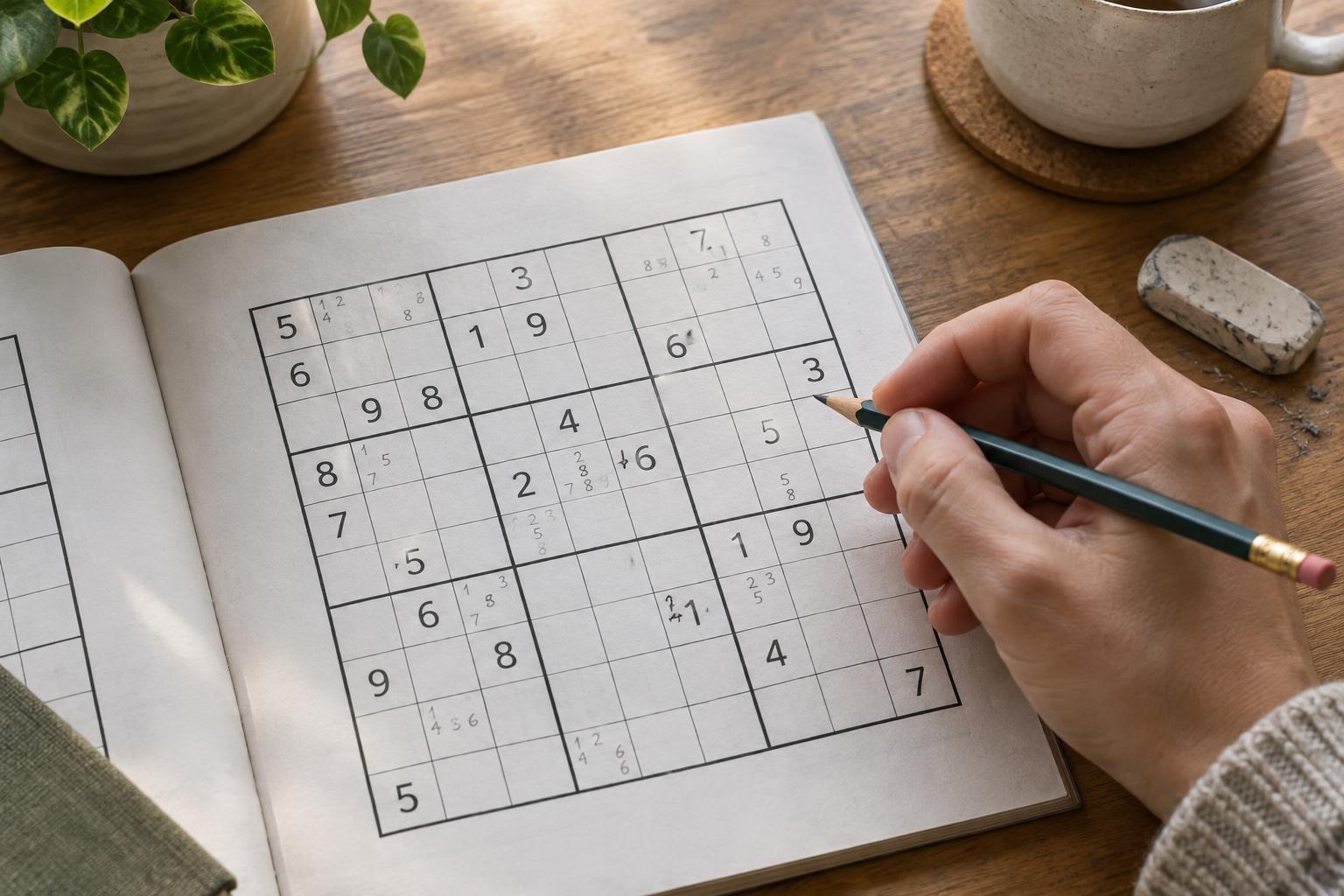
Pencil marks are small candidate numbers written inside an empty cell. They show what could go there based on the clues and numbers already placed. If a cell’s row is missing 1, 3, and 7, but its column contains 1, you can rule out 1. If its box also contains 7, write a small 3 in the cell—or fill in 3 if you have checked all three groups.
You do not have to mark every cell at once. On paper, that can make a beginner’s grid crowded; in a digital puzzle, it can create a screen full of tiny numbers. Try adding candidates to a promising row, column, or box, then update those marks as you place numbers. Cross out a candidate whenever its digit appears elsewhere in the same row, column, or box.
Two useful discoveries come from candidate marks. A cell with only one candidate is a single: that number belongs in the cell. A group may also have only one place for a particular digit, even if that cell still shows several candidates. For instance, if three cells in a box could hold various numbers but only one of them could hold 9, put 9 there.
Avoid the most common beginner mistakes
The most tempting mistake is to treat a likely answer as a certain one. A cell with two candidates is not solved, even if one seems more promising. If you guess and the guess is wrong, later placements may look logical while resting on that error. For straightforward beginner puzzles, careful scanning and updated pencil marks are usually a better first approach.
Another common slip is checking a row and column but forgetting the box. Trace the borders of the 3-by-3 box before confirming a placement. It is also worth distinguishing printed clues from your own entries, especially when erasing or revising marks. A clue is fixed; a candidate is only a possibility.
If progress stops, check your recent placements rather than adding more numbers at random. Look for a repeated digit in a row, column, or box, then revisit any candidate marks affected by a new entry. A stale pencil mark can make a cell appear less certain than it really is.
Build a simple solving routine
A steady routine makes Sudoku easier to follow. First, scan groups with many clues for obvious missing digits. Next, check where a chosen digit can fit within each box. Add pencil marks where those checks do not produce an answer, and look for cells with one candidate or digits with only one possible place in a group. After every placement, repeat the scan.
Try to keep your reasoning visible to yourself: “This column already has 7, and this box already has 7, so 7 cannot go in those cells.” You do not need to write out every thought, but being able to explain a placement helps you catch mistakes. If the grid feels busy, take a short break and return to a different row, column, or box.
With practice, you will notice restrictions more quickly. The aim is not to fill cells as fast as possible; it is to make one well-supported placement at a time. Each correct number removes possibilities, and those smaller sets of possibilities are what eventually bring the whole puzzle into view.