How a Kakuro grid works
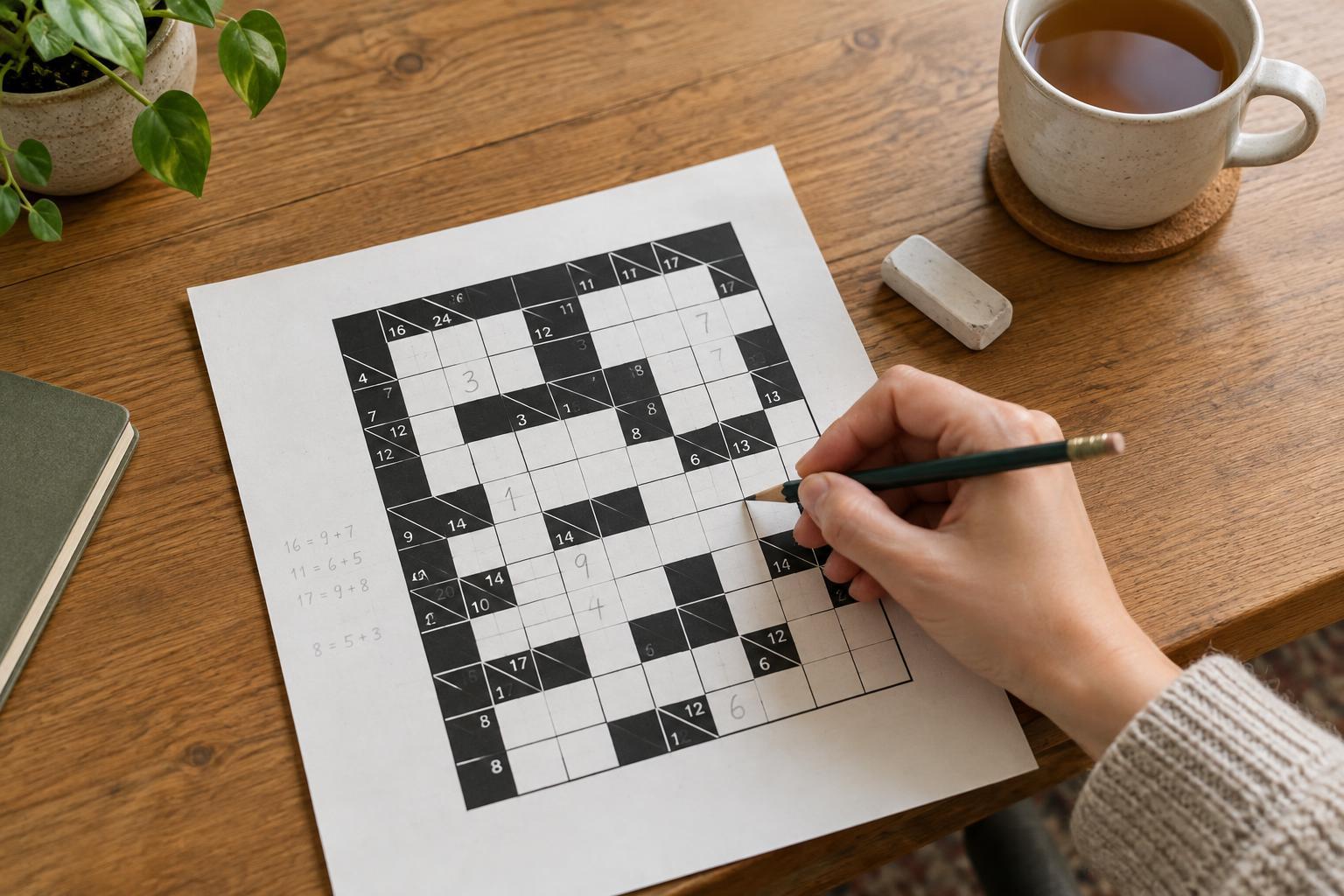
Kakuro is a number puzzle built from white answer cells and dark clue cells. Each clue gives the total for a connected group of white cells, called a run. Runs go either across or down, and each white cell belongs to one run in each direction. Fill the white cells with digits from 1 through 9 so that every run reaches its clue total.
There is one more rule: a digit cannot appear twice in the same run. A three-cell run totaling 7 could contain 1, 2, and 4, but it could not contain 1, 3, and 3. The same digit may appear elsewhere in the grid, including in a different run. If a clue cell contains two numbers, one refers to the across run and the other to the down run; check the grid’s clue layout before you begin.
Start with combinations, not cell order
A clue tells you both a sum and the number of cells available to make it. Together, those facts can sharply limit the possibilities. For example, a two-cell run totaling 4 must use 1 and 3. A two-cell run totaling 16 must use 7 and 9. You know which digits belong in each run, even if you do not yet know their order.
Small and large totals are useful starting points because they often have few valid combinations. Three distinct digits can total as little as 6, using 1, 2, and 3, or as much as 24, using 7, 8, and 9. A three-cell run totaling 7 must use 1, 2, and 4. When considering combinations, use each digit at most once; arrangements of the same digits are not new combinations.
A short note beside a run can help: list its possible digit sets before trying to place anything. You do not need to memorize a full combination chart. Begin with clues that have only one or two plausible sets, then return to more flexible runs after their crossings provide extra information.
Let crossing runs choose the position
Across and down runs meet at white cells, and that shared cell must satisfy both clues. Suppose a two-cell across run totals 16, so its digits are 7 and 9. If one of those cells also belongs to a two-cell down run totaling 10, consider what the crossing cell could be. The down run cannot contain 9, because its other digit would have to be 1, which actually makes 9 possible; it can also contain 7 with a 3. At this stage, the crossing alone does not decide between them.
Now imagine that the other cell in the down run crosses an across clue that rules out 1 but allows 3. The crossing cell must then be 7, leaving 9 for the other cell in the 16 run. This is the central rhythm of Kakuro: find the possible digits for a run, compare them at crossings, and revisit the run whenever one possibility disappears.
Use the remaining sum carefully
Once a run has some filled cells, subtract their values from its clue. If a three-cell run totals 15 and already contains 4, its two empty cells must total 11. They cannot include another 4. Possible distinct pairs include 2 and 9, 3 and 8, or 5 and 6; crossing runs will determine which pair fits.
This subtraction is especially helpful near the end of a run, but always check the no-repeat rule before writing the last digit. If a run totals 12 and its first two cells contain 3 and 4, the final cell would need to be 5. If that final cell’s down run already contains a 5, something earlier needs another look. Treat a contradiction as a prompt to review your reasoning, not as a reason to force a different number into the cell.
Build a steady solving routine
Scan the grid for short runs and unusually low or high totals. Record their possible digits, then inspect the cells where they cross other constrained runs. Fill a cell only when its value is certain; otherwise, keep a small set of candidates and move on. Each confirmed digit can simplify two runs, so a modest discovery may open up several clues.
When progress slows, check what every unfinished run still needs to total and whether its remaining digits can fit without repetition. It can help to work through the grid in passes rather than staring at one clue. With practice, Kakuro becomes less about doing large amounts of addition and more about noticing how a few simple restrictions work together.