Start with the shape of the words
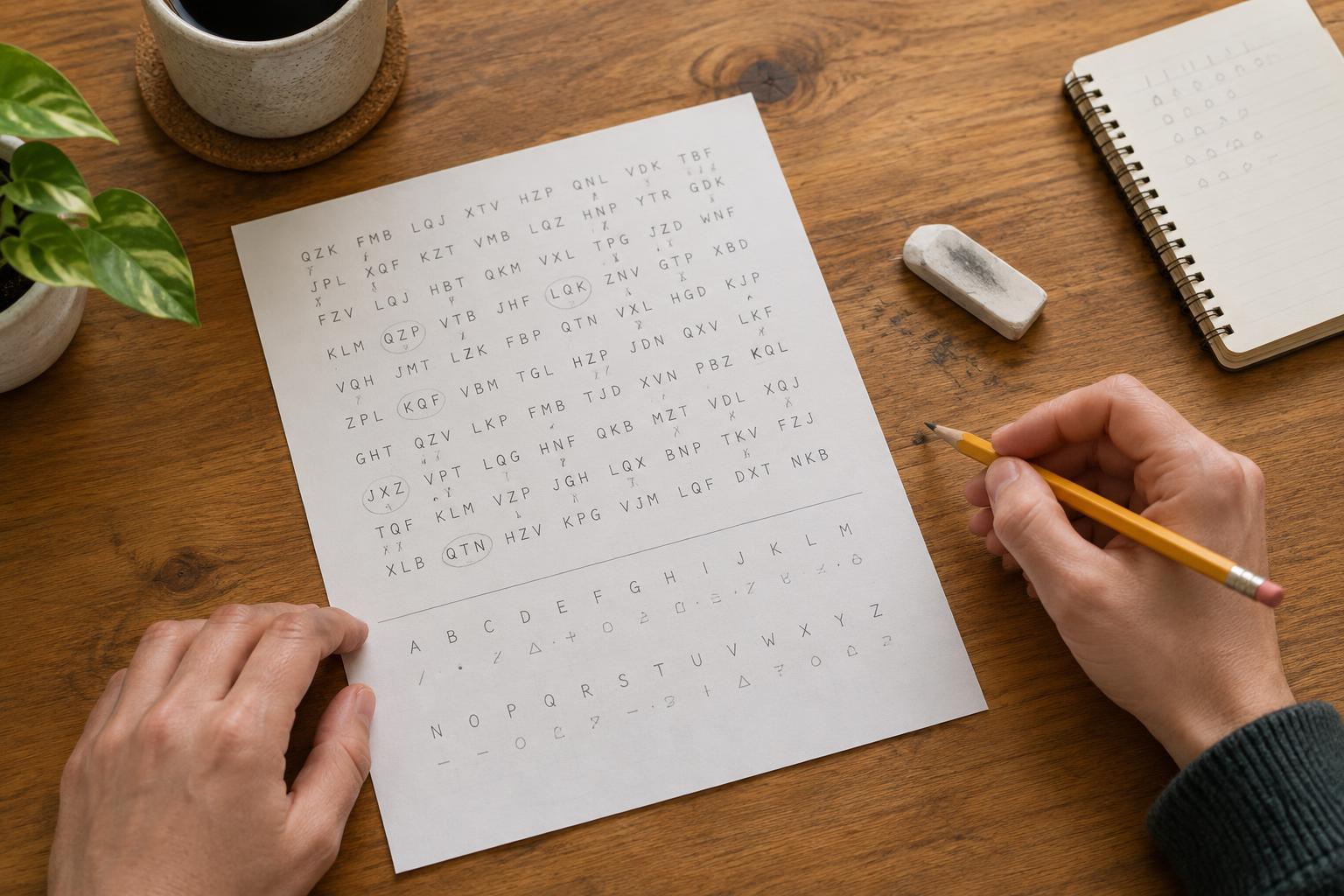
In a standard substitution cryptogram, each letter of the original message has been replaced by another letter. The replacement stays the same throughout the puzzle: if one coded letter stands for E in one word, it stands for E everywhere. Spaces and punctuation usually remain in place. Your job is not to guess every word at once, but to find small patterns that make possible words easier to test.
Begin by looking at word lengths and repeated letters. A coded word shaped ABBA has the same first and last letter, plus a matching pair in the middle. NOON and DEED both fit that shape; TABLE does not. A word shaped ABCA repeats its first letter at the end, as in AREA. The pattern does not reveal the answer by itself, but it rules out many tempting guesses before you write them down.
Use short words as starting points
One-letter words are useful because ordinary English prose generally uses A or I. If the puzzle contains a single coded letter, pencil in one possibility and check where that letter appears in longer words. Treat it as a test, not a conclusion. A guess that produces several plausible fragments is more promising than one that solves only the isolated word.
Two- and three-letter words provide more places to look. Words such as TO, OF, IN, THE, AND, and YOU are familiar candidates, but length alone is weak evidence. Compare how a short coded word appears beside its neighbors, and check whether its letters recur elsewhere. If a three-letter word appears often, THE may be worth trying. It is still only a guess until the resulting letters make sense across the message.
Keep one consistent letter key
As you test words, maintain a simple key with coded letters on one row and their proposed plain letters beneath. Fill in a pairing only when you can see what it does to other words. In a standard one-to-one substitution, two different coded letters cannot both represent the same plain letter. That rule catches errors that are easy to miss when you focus on a single phrase.
For a small example, imagine the coded fragment GSV XZG HZG. The reading THE CAT SAT is consistent: G represents T in both THE and the ends of CAT and SAT; Z represents A in the latter two words. The matching endings of XZG and HZG helped suggest CAT and SAT. This does not mean every similar-looking fragment has that answer. It shows how a candidate phrase should respect every repeated letter, not just sound natural.
Build from patterns to context
Once you have a few reliable letters, scan the whole cryptogram again. Partial words often expose useful structures: a repeated final pair might suggest an ending such as -LL or -SS, while several words sharing the same last three coded letters may share a common ending. Check each idea against the key before committing to it. Endings, like short words, are clues rather than guarantees.
Read the surrounding words, too. Grammar can help distinguish candidates with the same pattern. After “the,” for instance, a noun or adjective may be more likely than a verb, depending on the sentence. Context is most helpful when paired with letter evidence. If a guess makes one phrase read smoothly but creates impossible-looking words elsewhere, leave it in pencil and try another interpretation.
Know when to erase a guess
Getting stuck often means an early assumption is doing too much work. Go back to the first uncertain letter you entered and ask what supported it. Was it based only on a common word, or did it also explain repeated letters in several places? Erase weak guesses before adding more. A clean key with a few dependable pairings is easier to use than a crowded one full of contradictions.
A steady solving routine is to mark word shapes, test short words, record consistent pairings, and revisit the entire message after each useful discovery. If a puzzle offers very little text, several answers may remain possible until a later clue settles them. That uncertainty is part of the appeal: letter patterns narrow the field, while careful checking turns a plausible guess into a convincing solution.