One grid, two ways of asking
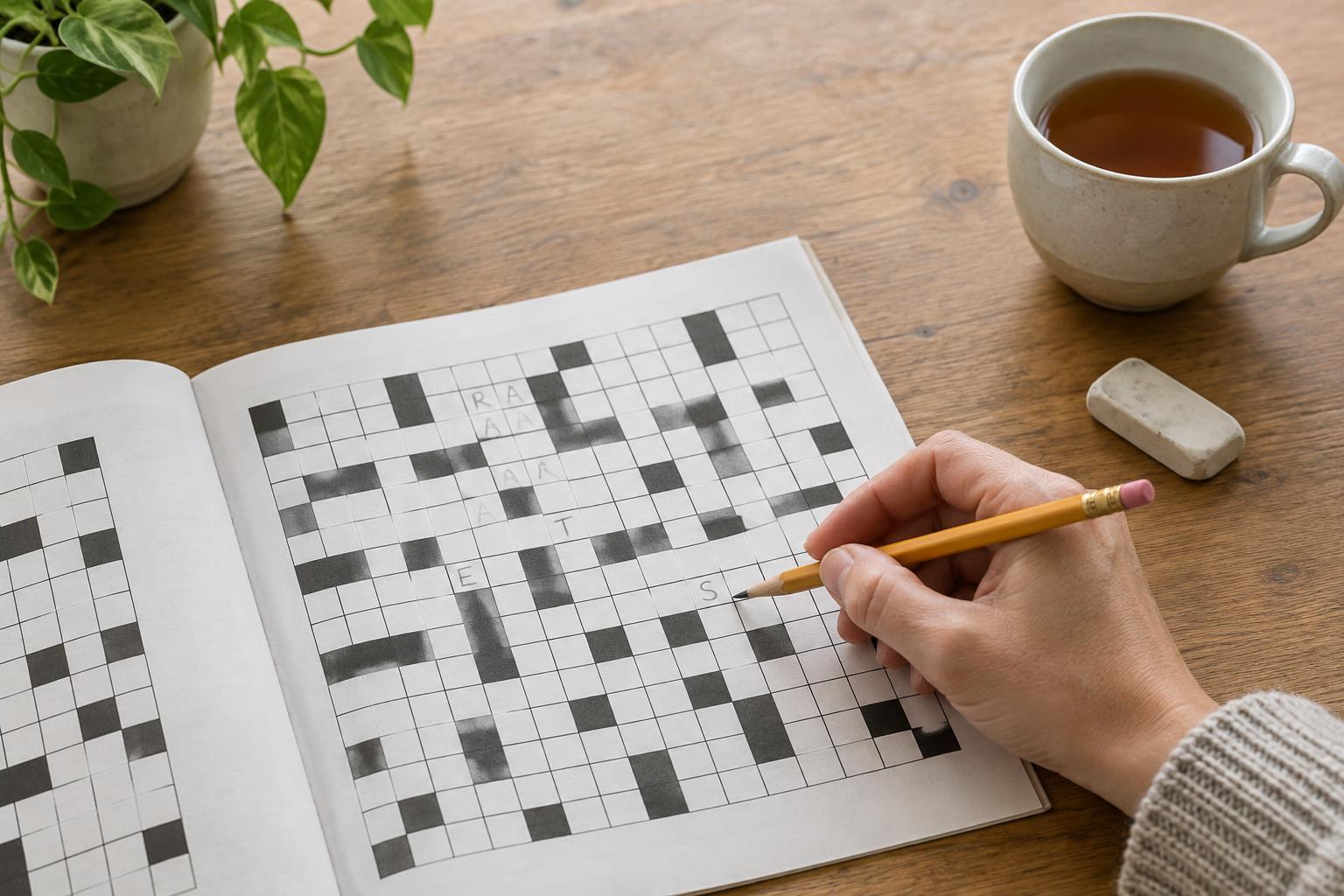
At first glance, standard and cryptic crosswords look much alike. Both place answers in a grid, and both use crossing letters to help you fill gaps. The difference is what a clue asks you to do. A standard clue usually points toward an answer through a definition, description, synonym or familiar association. For example, “Small domesticated feline (3)” leads directly to CAT.
A cryptic clue generally offers two routes to the same answer: a definition and a piece of wordplay. “Feline concealed in scatter (3)” also leads to CAT. “Feline” defines the answer, while “concealed in scatter” tells you to look inside the word SCATTER, where the letters CAT appear together. The rest of the clue is not just decoration; it helps you discover and check the answer.
What a standard clue expects
In a standard crossword, start by asking what the clue means. “Rapid (5)” might suggest QUICK or SWIFT, so the crossing letters help settle which answer fits. Clues may also ask about a word’s other meanings. “Current (7)” could refer to something happening now or to a flow of water or electricity. The grid, clue phrasing and any known letters narrow the possibilities.
Difficulty often comes from choosing among plausible answers rather than decoding a hidden set of instructions. A short clue can be hard because it offers little context. A longer clue may guide you more clearly, though it can still use a playful turn of phrase. Paying attention to answer length, tense and whether an answer should be singular or plural can save time before you put anything in the grid.
How a cryptic clue gives instructions
A conventional cryptic clue usually puts its definition at the beginning or end. The remaining words build the same answer through an operation involving letters, sounds or meanings. One common operation is an anagram: a word such as “stirred” may signal that nearby letters should be rearranged. In “Flower from ores stirred (4),” ROSE is a flower and can be made by rearranging ORES. The clue works only when both routes agree.
Other clues hide an answer inside a longer word or phrase, use a sound-alike, join smaller pieces or ask you to remove letters. Words such as “concealed,” “heard,” “initially” and “without” can signal those actions, depending on their context. They are hints, not universal commands: a word that signals an anagram in one clue may simply be part of the surface meaning in another.
That surface meaning is part of the fun. A cryptic clue is often written to read like an ordinary sentence, even while its pieces perform separate jobs. If the sentence seems to lead nowhere, try setting its apparent story aside. Look for a possible definition at either end, then ask what the middle could be telling you to do.
A practical approach to each style
For a standard puzzle, make a quick pass through the clues and fill in answers you feel confident about. Return to uncertain clues once crossing letters give you a pattern. If you have _ A T for a three-letter feline, CAT becomes much easier to confirm. Keep tentative answers in mind rather than forcing every clue to fit your first guess.
For a cryptic puzzle, begin with clues whose instructions you recognize. Check the answer length, test a likely definition and examine the other words for letter operations. Write out anagrams or hidden-letter sequences if holding them in your head becomes awkward. When an answer fits the grid but you cannot explain its wordplay, treat it as provisional; understanding both halves is a useful check.
Neither style requires the same solving mood every time. Standard clues reward flexible vocabulary and attention to context. Cryptic clues reward patient parsing and a willingness to read a sentence in two ways. Once you know what each clue type is trying to give you, the grid stops being a wall of blanks and becomes a collection of smaller, manageable decisions.