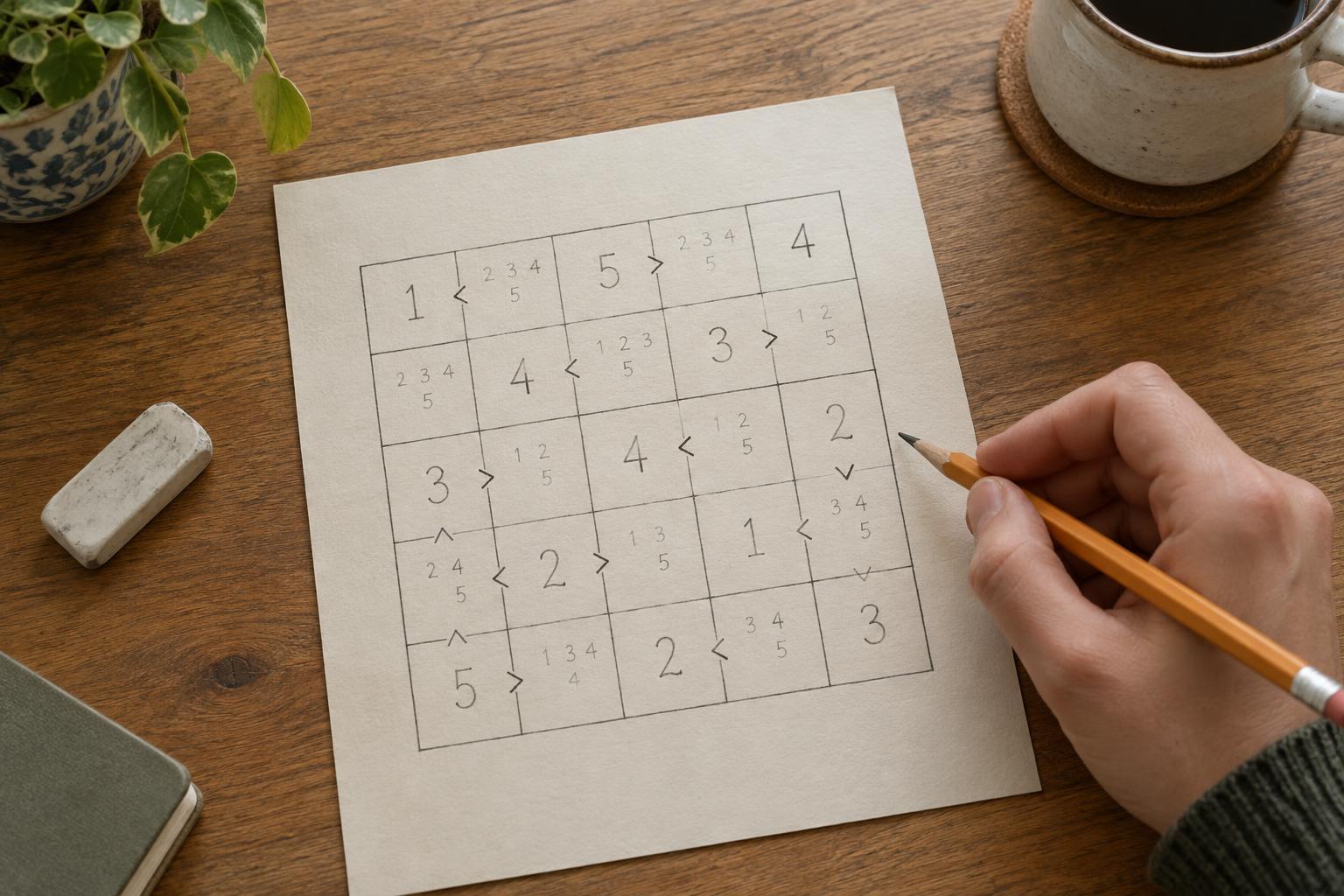
What the symbols add to a number grid
Futoshiki is a grid puzzle in which you place numbers so that each row and column contains every permitted number exactly once. In a 4-by-4 grid, for example, each row and column must contain 1, 2, 3 and 4. The extra clues are inequality symbols between neighboring cells. The narrow end of a symbol points toward the smaller number: 2 < 4 and 4 > 2.
A symbol tells you only about the two cells it connects. If one cell must be less than its neighbor, it does not necessarily hold the smallest number in the row. Likewise, a pair of adjacent cells without a printed symbol has no inequality requirement between them. Before solving, check the grid size and any instructions printed with the puzzle; these establish which numbers belong in the grid.
Start with numbers that cannot fit
Inequalities become useful when you ask which numbers are impossible. In a 4-by-4 grid, a cell on the smaller side of a symbol cannot be 4, because no permitted number is greater than 4. A cell on the larger side cannot be 1. Those exclusions may seem small, but they can combine with numbers already placed in a row or column.
Suppose a cell must be less than the cell to its right. If its column already contains 1 and 2, its only remaining possibilities might be 3 and 4. The inequality rules out 4, leaving 3. Its neighbor must then be 4. After placing both numbers, check their columns again: each new placement may remove a candidate elsewhere. This back-and-forth between row, column and inequality clues is the core solving rhythm.
Use chains without jumping to conclusions
A chain of symbols gives stronger information than a single symbol. If three cells in a 4-by-4 row satisfy A < B < C, then A cannot be 3 or 4, B cannot be 1 or 4, and C cannot be 1 or 2. The chain does not, by itself, prove that the cells contain 1, 2 and 3. They could contain 2, 3 and 4 instead.
Now imagine the fourth cell in that row is already filled with 1. Because a row cannot repeat a number, A, B and C must contain 2, 3 and 4. The chain fixes their order: A is 2, B is 3 and C is 4. This illustrates a helpful habit: use inequalities to restrict order, then use the row and column rules to determine which numbers are available.
Keep candidate notes small and readable
When a placement is not certain, write the possible numbers lightly in the cell rather than choosing one. Begin with numbers missing from that cell’s row and column, then remove any that conflict with its inequality neighbors. You do not need to fill every empty square with notes at once. Concentrate on cells beside several symbols or in nearly complete rows and columns.
Revisit candidates after each confirmed placement. A cell that once allowed 2 or 3 may become a definite 2 when another cell in its column takes 3. If your notes become crowded, erase and rebuild them from the current grid. Notes are a record of what is still possible, not a set of guesses you must preserve.
Check the whole grid before finishing
If progress stalls, scan for a number that has only one available position in a row or column. Then inspect inequality chains again; a new placement may have tightened a bound at the other end of a chain. Work from confirmed exclusions rather than assuming that an attractive-looking pattern must be correct.
When every cell is filled, perform two separate checks. First, confirm that each row and column contains every permitted number exactly once. Second, read every inequality in the direction it is printed and compare the two neighboring values. A grid can satisfy the row and column rules while still breaking one symbol. Taking a moment for both checks helps catch a reversed sign or a number copied into the wrong square.