Start with the rules
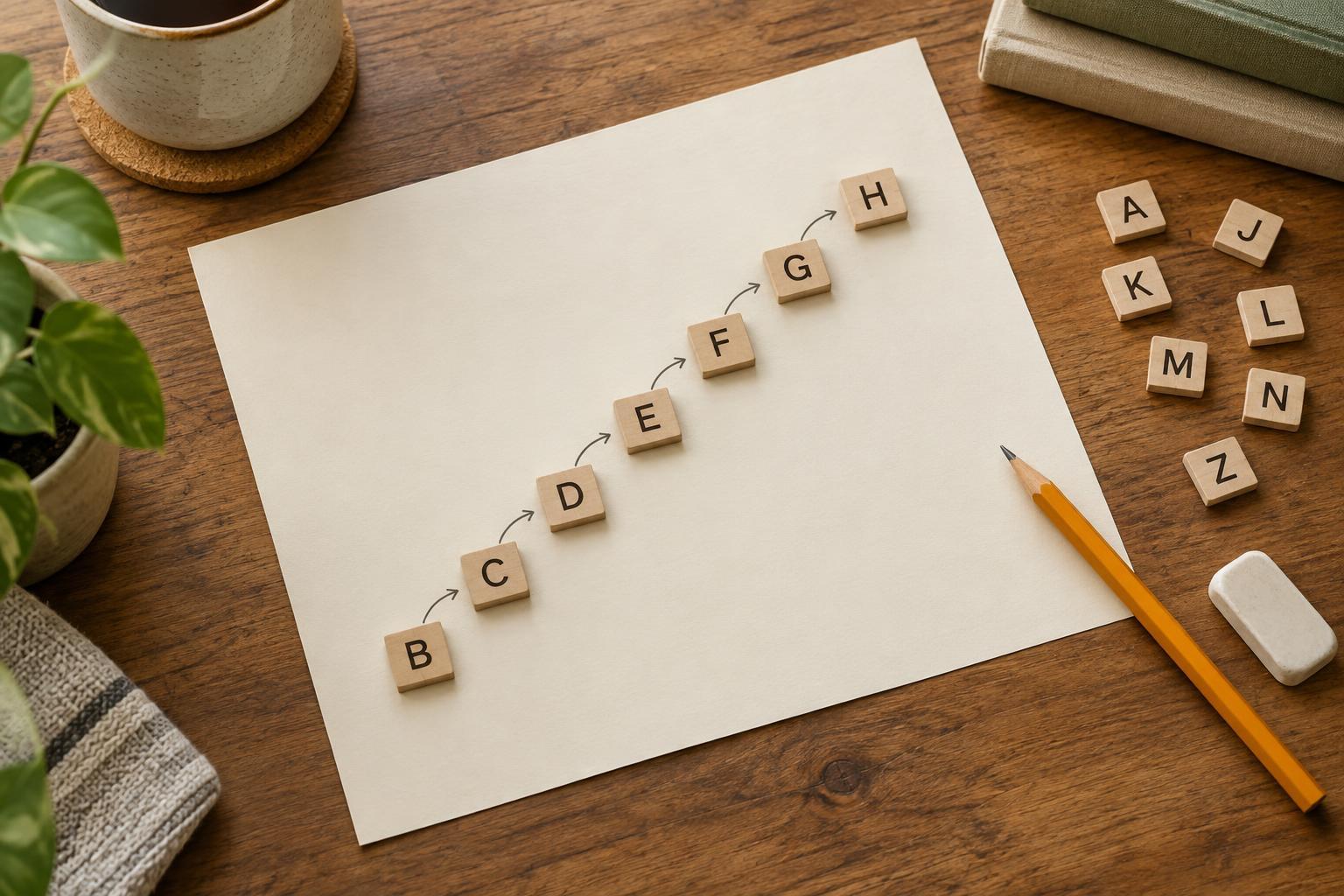
A word ladder asks you to transform a starting word into a target word. Each step must be a valid word of the same length, and each new word must differ from the previous one by exactly one letter. You may change any position, but you cannot rearrange letters or add and remove them. Most puzzles also expect you to avoid repeating a word.
For example, CAT can become DOG in three moves: CAT, COT, DOT, DOG. CAT to COT changes one letter; COT to DOT changes another; and DOT to DOG changes a third. A move such as CAT to ACT would not count, because it rearranges letters rather than changing one letter in place.
Before solving, check which words the puzzle allows. Some word lists accept plurals, uncommon words or verb forms that others exclude. If you are playing with friends, agreeing on a dictionary or a simple standard such as familiar everyday words prevents an otherwise enjoyable puzzle from turning into a debate.
Compare the endpoints before making a move
Write the starting and target words one above the other. Notice which letter positions already match and which need to change. If three positions differ, you will need at least three moves: a single move can correct only one position. That is a lower bound, not a promise. You may have to change a letter twice to travel through usable words.
Matching letters are useful guides, but they are not locked in place. Suppose you are trying to move from COLD to WARM. None of the letters match in the same position, so at least four moves are needed. One route is COLD, CORD, CARD, WARD, WARM. Every move changes one letter, and the ladder reaches the target in four moves.
As you consider a next word, ask two questions: does it bring a letter closer to the target, and does it leave room for further moves? A word that looks promising because it matches more target letters may have few useful neighbors. A temporary detour can be better than a perfect-looking step into a dead end.
Work backward as well as forward
It is natural to begin at the starting word and keep searching for its neighbors. When that search stalls, try the target instead. Write down words one letter away from it, then look for a connection between the two growing chains. This can expose a route that is hard to see when you focus on only one end.
Keep your trial words in columns or short branches rather than erasing each attempt. For a three-letter word, try changing the first letter while keeping the last two fixed, then repeat for the middle and final positions. This organized scan helps you find options you might miss by waiting for words to spring to mind.
If you find several possible moves, you do not need to commit immediately. Sketch a few branches and follow each for a step or two. A branch that offers several valid next words is often more useful than one with a single exit, even if it initially moves away from the target spelling.
Recognize detours and dead ends
A dead end is a word from which you cannot find a useful legal next step. It does not mean the puzzle is impossible. Return to the last point where you had another choice and test a different neighbor. If you keep circling back to words you have already used, mark that branch as explored so you do not waste time retracing it.
Pay attention to groups of words with similar spellings. A shared ending may give you several ways to change the first letter, while a common vowel change may open a new set of options. These groups act like junctions: they give you flexibility to switch which letter position you are working on. The goal is not to fix letters in a particular order but to find a continuous chain of valid words.
When you think you have finished, check the ladder line by line. Confirm that each entry has the right number of letters, each adjacent pair differs in exactly one position, and every word fits the agreed word list. Then consider whether a shorter route is possible if the puzzle asks for one. A valid ladder and a shortest ladder are not always the same thing.
Make practice puzzles that teach you something
To practice, start with two familiar words of the same length and see whether you can connect them. Three- and four-letter words are manageable places to begin. You can also take a completed ladder, hide its middle words and give the endpoints to a friend. If they find a different route, compare where your paths branch and rejoin.
For a relaxed game night, decide in advance whether players are racing, collaborating or trying to use the fewest moves. A shared sheet of paper makes it easy to test branches together. The most rewarding habit is to treat every failed route as information: it shows which changes are available, which are awkward and where to explore next.