What thinning is meant to achieve
Acrylic paint straight from the bottle can be thick enough to leave brush marks or fill tiny features such as buttons, folds, and facial details. Thinning makes it easier to spread a controlled coat across the miniature. The goal is not to make every paint watery; it is to find a consistency that flows off the brush while still leaving enough pigment where you put it.
There is no reliable water-to-paint ratio for every color or brand. Paints vary in thickness and opacity, and even the same bottle can change as it ages. Instead of following a fixed recipe, start with a small amount of paint on a palette and add water a drop at a time. Mix thoroughly, then check how it behaves before adding more.
Find the right consistency with a quick test
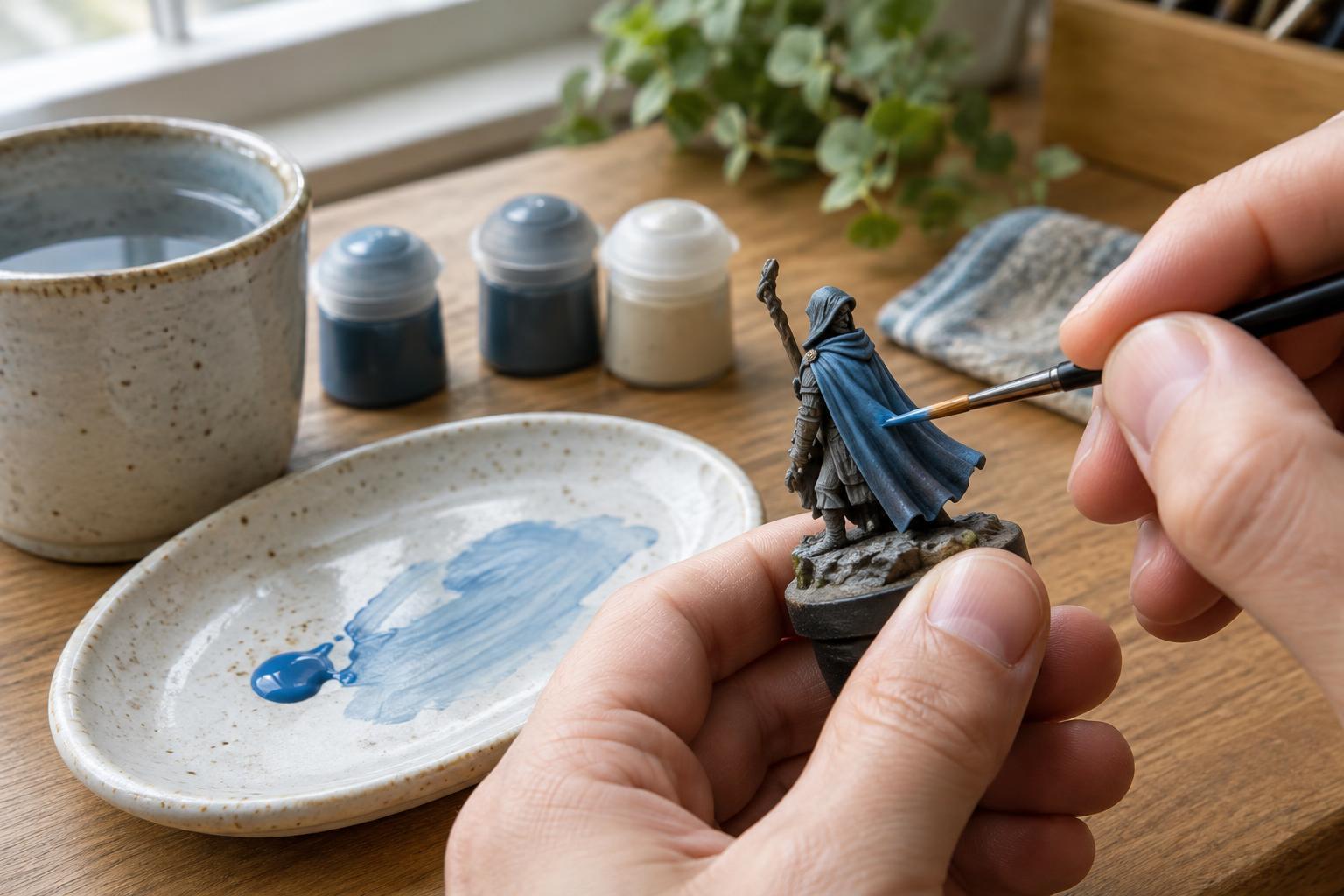
For a base coat, aim for paint that moves easily under the brush but does not race across the palette when you tilt it slightly. Draw a short stroke on a primed spare miniature, an old plastic part, or another suitable test surface. The stroke should look fairly even, with sculpted detail still visible beneath it. If the brush drags and leaves ridges, add a little water. If color gathers at the edges and leaves the middle nearly bare, the mixture may be too thin for that task.
Before testing, touch the loaded brush to a clean area of the palette or a paper towel to remove excess liquid. A brush holding too much paint can flood recesses even when the mixture itself is useful. If you accidentally add too much water, mix in a little more paint rather than trying to force a puddle onto the miniature.
A damp palette, including a wet palette, can give you more time to work before paint dries. It may also add moisture gradually, so revisit the test if the mixture starts behaving differently. Keep the palette clean enough that stray colors do not make it harder to judge coverage.
Keep coverage by working in thin coats
Thin paint often looks less opaque in its first pass. That is normal: one smooth coat does not need to hide the primer completely. Apply a modest amount, spread it evenly, and let it dry before judging whether it needs another coat. Repeatedly brushing over paint as it begins to set can lift the surface and create texture.
Primer color affects how many coats appear necessary. A dark primer may show through a light yellow or pale cream more readily than through a deep blue or brown. For a difficult light color, consider painting a suitable mid-tone underneath, then adding the final color in thin layers. This can be more controlled than applying one thick coat in an attempt to cover everything at once.
Work from one part of the miniature to the next so each area has time to dry. When the first coat is dry, a second thin coat can even out streaks without burying edges and recesses. If a spot remains patchy, place the next coat where it is needed rather than automatically adding paint to the entire model.
Adjust the mixture to the job
Base coating, highlighting, and shading do not require identical paint. For a base coat, use enough dilution to prevent ridges while retaining color. For a small highlight, a controlled brush with less paint is often more important than extra water. You want the tip to make a clean mark, not release a bead of liquid that spreads beyond the raised edge.
A more transparent mixture can be useful when you deliberately want to build subtle color over several passes. In that case, thin layers are the point, and full coverage in one stroke would work against the effect. Keep each pass light and let it dry before adding another. If you want transparency without making the paint runny, an acrylic medium made for miniature or hobby paints may help, though its behavior will depend on the product.
Water is a practical starting point for ordinary brush painting. Additives such as flow improver are different from simply adding more water; use them according to their labels and test them in a small mixture first. Keeping adjustments small makes it easier to tell which change helped.
Troubleshoot the finish, not just the mixture
If detail disappears, check both paint thickness and how much is on the brush. If paint pools around details, unload the brush and use a smaller amount per pass. If coverage is streaky, allow the coat to dry fully before adding another, and consider whether the underlying color is making the result look uneven. These problems can look similar at first but call for different fixes.
A useful routine is to mix a small amount, test one stroke, paint a limited area, and pause to inspect the dry result. Over time, this teaches you what the right consistency feels like with your own paints and brushes. The aim is not a perfect ratio: it is a repeatable way to leave color on the miniature while keeping its details crisp.