Start with a problem worth solving
An invention challenge asks players to make something useful, amusing, or surprising from a limited collection of objects. The invention does not need to work perfectly. A paper prototype, a moving model, or a convincing demonstration can all count. What matters is that players connect a problem to an idea and show how their creation might help.
Choose one prompt for the whole group so everyone has a common starting point. Try “Move a small object across the table without touching it directly,” “Keep a pencil from rolling away,” or “Make a desk companion that reminds someone to take a break.” A clear prompt gives the challenge direction while leaving room for different solutions. For a sillier round, ask for an invention that solves a tiny inconvenience in an unnecessarily elaborate way.
Keep the scope suited to your group. A tabletop problem is easier to test than an invention meant to change an entire room. If children and adults are playing together, use a prompt with several possible approaches rather than one that rewards specialized knowledge.
Build a safe and flexible materials pile
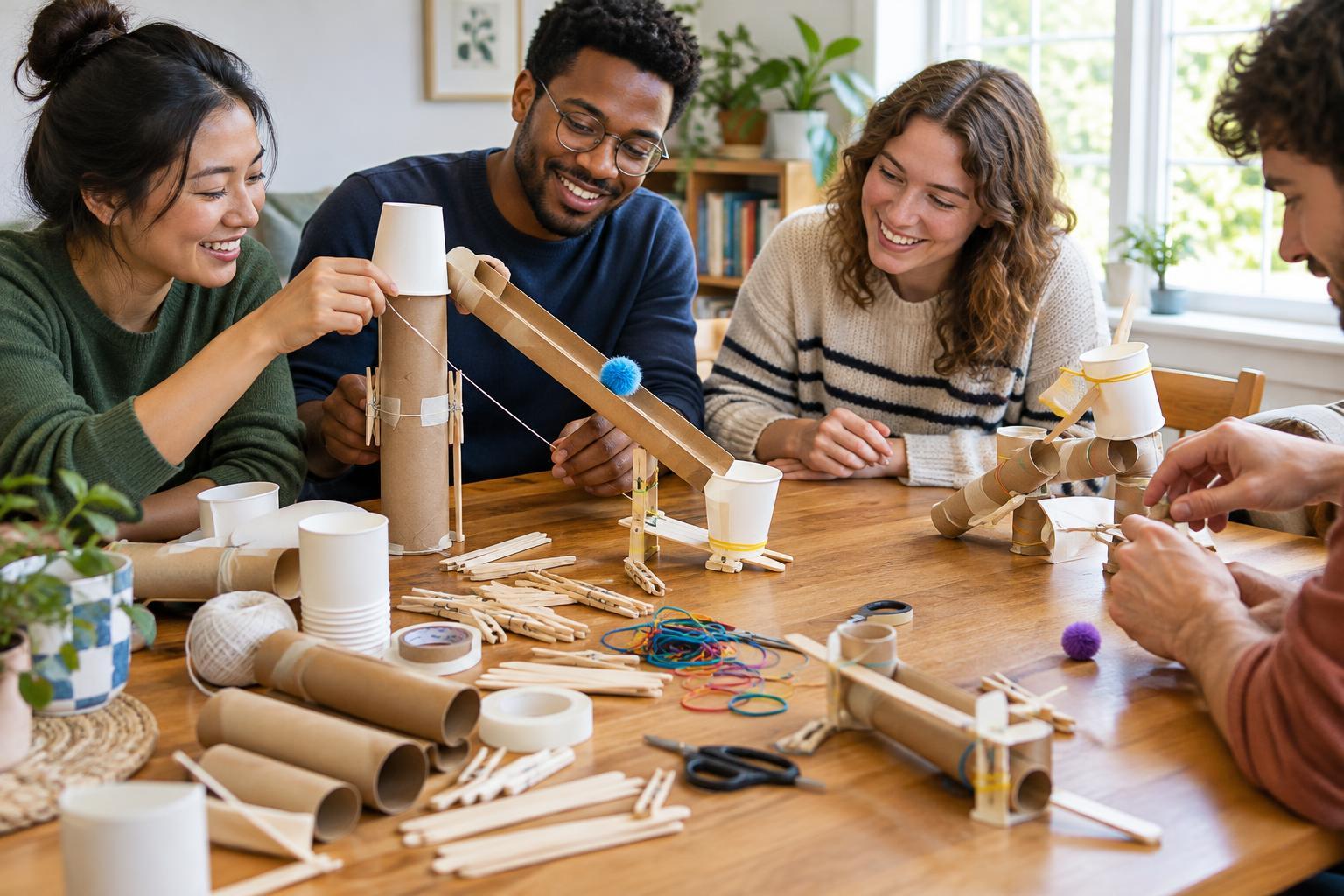
Gather clean objects that can be handled without damaging them or the space. Cardboard scraps, paper, rubber bands, string, clothespins, empty containers, craft sticks, tape, and reusable building pieces offer plenty of variety. Add a few odd shapes, such as a cardboard tube or a spare lid, to encourage unexpected combinations. Set aside anything fragile, sharp, valuable, or likely to spill.
Put the materials where everyone can see them. You can give each team the same small kit, or make one shared supply table. Equal kits make it easier to compare different approaches to the same constraints. A shared table creates more opportunities to negotiate and trade ideas. If supplies are limited, ask players to take only what they need at first and return unused pieces.
Decide in advance whether cutting is allowed and who may handle tools. Tape and folding may be enough for a casual round. If a proposed invention would require heat, electricity, or another risky step to function, invite the player to represent that part with a drawing instead of attempting it.
Give the challenge a few simple rules
Explain the prompt, show the available materials, and set a build period that suits the group. Around twenty minutes can create lively decisions without making the activity feel rushed; a longer session gives players room to revise. Allow a short planning period before anyone takes supplies. Players can work alone, in pairs, or in small teams, depending on how much conversation you want.
A useful core rule is that each invention must use at least three objects from the pile and include a demonstration or explanation. Another option is to draw a surprise constraint halfway through, such as “It must fold flat” or “It must work with one hand.” Use surprise rules only if your group enjoys improvising; otherwise, they can interrupt a promising design.
Tell players how inventions will be celebrated before building begins. Rather than naming one overall winner, try categories such as simplest solution, most imaginative use of materials, best explanation, and funniest failure that led to a better idea. These categories make room for different kinds of creativity and keep the focus on sharing discoveries.
Make testing part of the fun
When build time ends, give each person or team a brief turn to introduce the problem, name the invention, and show what it does. For a pencil holder, place a pencil on the table and see whether it stays put. For an object mover, mark a start and finish point. Use the same basic test for similar designs, but allow players to explain features that are difficult to demonstrate.
A test that fails is still useful. Ask what the builder would change with five more minutes or one extra material. Perhaps a structure needs a wider base, a handle is awkward to grip, or a clever feature solves a different problem than intended. Keep feedback specific and curious: “What happens if the lid is turned over?” is more helpful than deciding an idea is simply good or bad.
If the group wants a second round, let players revise their own inventions or swap designs and improve someone else’s with permission. This turns the challenge from a quick contest into a shared experiment.
Reset the room and keep the best ideas
Leave a few minutes for cleanup and reflection. Sort reusable objects back into the materials pile, recycle suitable scraps, and take apart builds that cannot be stored. Players who want a record can sketch their inventions or write a one-sentence description of how each one works.
The format is easy to repeat without feeling identical. Change the prompt, limit the materials, or introduce a theme such as travel, pets, or a miniature workshop. You can also ask players to invent for a fictional character with an unusual everyday problem. A good household invention challenge does not depend on polished results: it gives ordinary objects a new purpose and gives everyone a reason to say, “What if we tried this?”