Start with the grid rules
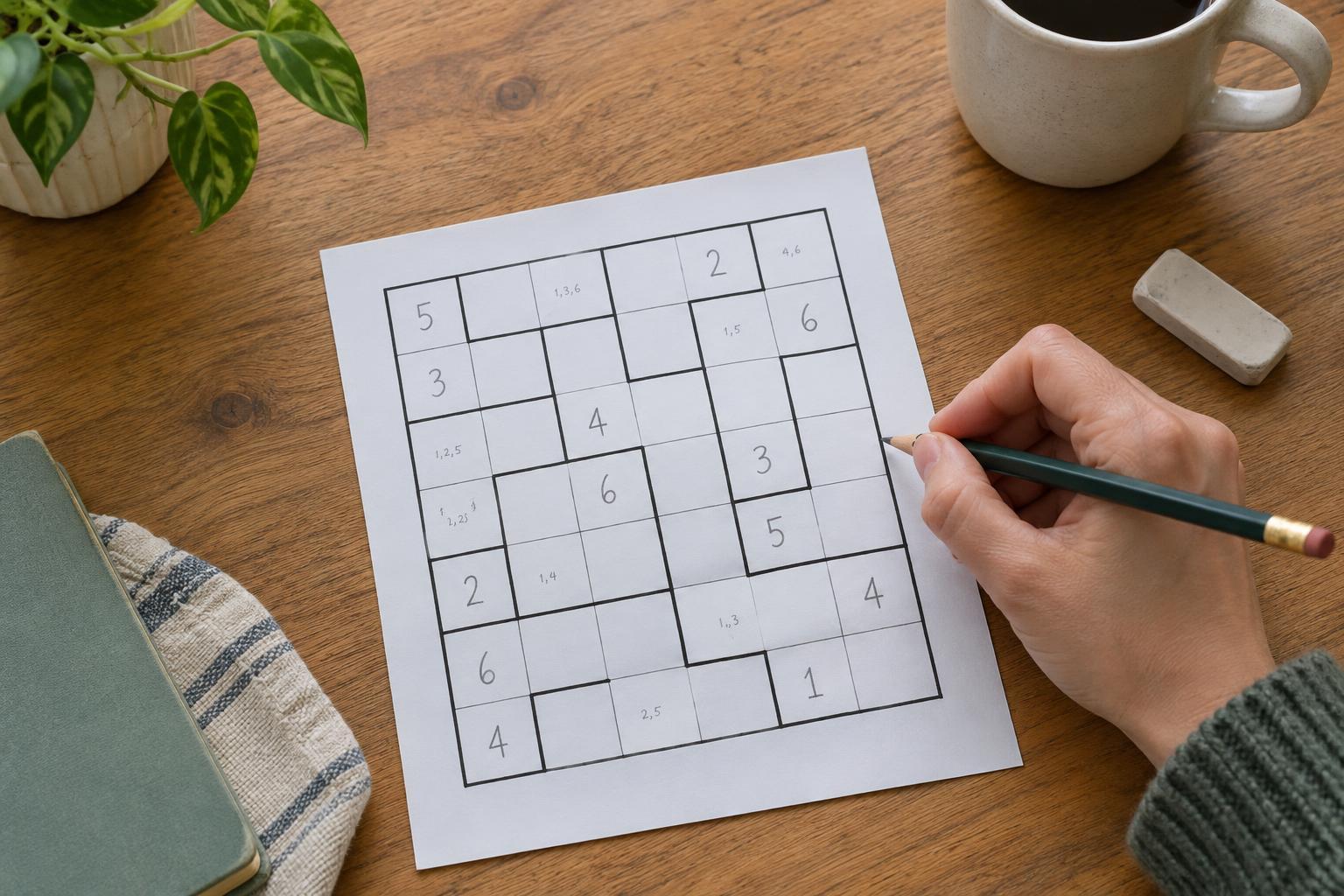
KenKen is a number puzzle built on two connected challenges. First, fill an N-by-N grid with the numbers 1 through N. In a 4-by-4 puzzle, for example, every row and every column must contain 1, 2, 3, and 4 exactly once. Second, the cells are grouped into outlined regions called cages. Each cage has a target number and, usually, an arithmetic operation. The numbers you place in that cage must produce its target.
Read both sets of rules together. A cage might have several number combinations that reach its target, but only some will fit the surrounding rows and columns. You do not need to solve each cage in isolation. Much of the pleasure of KenKen comes from switching between arithmetic possibilities and the grid’s no-repeat rule.
A one-cell cage is straightforward: its target is the number that belongs in that cell. Cages marked with addition or multiplication can contain several cells. Subtraction and division cages commonly contain two; for those, use the order that gives a nonnegative difference or a whole-number quotient. Check any special instructions printed with your puzzle, since conventions can vary.
Make a short list of cage possibilities
When you see an empty cage, list the numbers that could work before committing to an arrangement. In a 4-by-4 puzzle, a two-cell multiplication cage with a target of 6 must contain 2 and 3: 1 and 6 would exceed the grid’s range. You still need other clues to decide which cell gets which number. A two-cell subtraction cage with a target of 3 must contain 1 and 4.
Some targets leave more choices. A two-cell division cage with a target of 2 in a 4-by-4 grid could contain 1 and 2, or 2 and 4. Lightly noting both pairs beside the cage helps you avoid treating a possibility as a fact. As you learn something about either cell, revisit the list and cross out pairs that no longer fit.
For a larger cage, begin with the target and the smallest and largest numbers available. A three-cell addition cage totaling 7 in a 4-by-4 grid could use 1, 2, and 4; it could also use 1, 3, and 3 or 2, 2, and 3. Whether a repeated number is allowed depends on where its cells sit: two equal numbers cannot share a row or column, even when they belong to the same cage. Some puzzles state additional cage rules, so follow those if given.
Let rows and columns narrow the list
The shape of a cage matters as much as its arithmetic. Suppose two cells in a two-cell cage lie in the same row. They cannot hold the same number, because the row must contain each number only once. If a cage bends across multiple rows and columns, inspect the positions of any repeated candidates before keeping them on your list.
Next, look beyond the cage outline. Imagine a 4-by-4 division-by-2 cage that can hold either 1 and 2 or 2 and 4. If the row containing one cage cell already has a 4 elsewhere, that cell cannot be 4. This may rule out one arrangement, though it will not always settle the whole cage. Likewise, if a column already has a 2, remove 2 from the possibilities for any other cell in that column.
It helps to scan a nearly complete row or column after every placement. If a row contains 1, 3, and 4, its remaining cell is 2, regardless of how many combinations you originally listed for its cage. Place the 2, then update the rest of that cage. A clue found outside a cage can be the clue that completes it.
Solve steadily rather than guessing
Begin with cages that have few possibilities: single cells, restrictive products, or subtraction targets near the grid’s largest number are often good places to look. Write small candidate numbers in uncertain cells if your puzzle format allows it. Keep confirmed entries visually distinct from candidates so you do not accidentally build a deduction on a guess.
When you feel stuck, change what you are scanning. If you have been checking cages, inspect each row and column for a missing number. If you have been filling rows, return to a cage whose possible pairs have shrunk. You can also ask what cannot go in a cell: ruling out one candidate may make a neighboring cage or column easier to read.
Before entering a number, make two quick checks. Does it fit the cage’s target, and does it avoid repeating a number in its row or column? That small habit catches many mistakes early. KenKen is not a race to calculate every cage at once; it is a process of keeping a few sound possibilities, placing numbers when they are certain, and letting each placement simplify the grid.